HS30-H
Supporting Member
-
Joined
-
Last visited
Everything posted by HS30-H
-
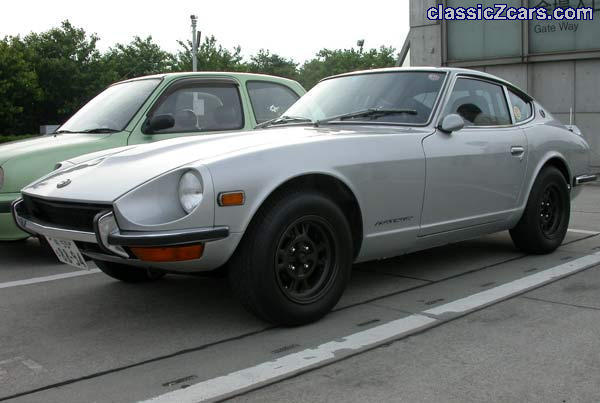
Diamond-shaped mesh in a square-tube frame. This grille was fitted to most of the Japanese domestic-market models. You might sometimes hear it referred to as the "432" grille, but that's not strictly accurate as the 432 got the same grille as the Fairlady Z and Fairlady Z-L. It was the 432-R grille that was slightly different. Not a particularly clear scan, but its an "official" Nissan side-by-side comparison and it might help: Alan T.

-
Hi Cuong, I just took a tour through the pictures. Great stuff. I was even moved to post a few comments ( I actually liked the Mine's, Central 20 and IMPUL Z33's - shock, horror! ). Thanks for taking the time to put them up there. I know how long it takes and sometimes it can be a bit disheartening when people don't seem all that enthused by them. I think this is a symptom of internet fatigue; people seem to think that they can see anything and everything on the web, but if it was not for people like you there would be a lot less chance to see this kind of thing. I urge everybody to take a look. Cuong visited the event and took the photos himself - so its not just a bunch of image captures from the web that he is posting. This is our window into an event that few of us get the chance to visit, and we should be thankful for that. This site is very lucky to have somebody like Cuong on board. Cuong, you can take some satisfaction from the obviously high amount of "hits" your photos are taking. I think a lot of visitors are being directed to this site to view your shots, and some of them might stick around. Well done Cuong, and many thanks. All the best, Alan T.
-
 Its an improvement, and its made by a company with a long Z-related history. I'm almost persuaded to buy one! Excellent!
-
 CENTRAL 20 - a great company with a very long Z-related history. Excellent.
-
 Excellent.
-
 MINE'S - great company, great car. Love it.
-
 Tried to get the wife to agree to us buying a Stagea as our every-day car. She smelled a rat immediately! Couldn't get her consent. Damn.
-
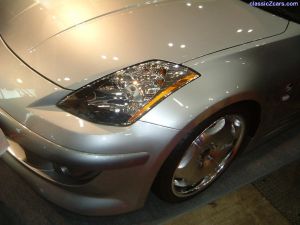 IMPUL have a very close connection with Nissan, so they probably have more right to do this kind of thing than almost anybody else. Top marks. I think it looks great.
-
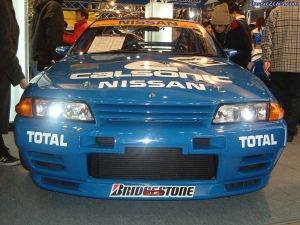 The CALSONIC R32 GT-R's are landmarks in Japanese domestic race history. Fanstastic.
-
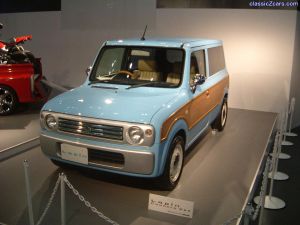 Love their spirit.
-
 MINE'S are a very well-respected Japanese company with a good history. Their products are always tasteful and work right. Looks like they are continuing this tradition with their Z33 parts. Thanks for posting these photos, Cuong.
-
The emblems were carried through to the Japanese market C-S31 and C-GS31 models too. Here's a scan from the relevant Japanese market model information booklet for those models. This "NISSAN" emblem had the part no. 90808-E4125 too. The "NISSAN - full auto - MATIC" emblem used the part no. 90809-E8225 I believe. Alan T.

-
Here's a scan of the cover of the slightly later Japan market S30-A ( Automatic ) model information booklet. This was published to familiarise the dealers with the alterations and differences that the Automatic version had undergone in the months since it was released. It was published in October 1970. The "Full Automatic" emblem can be seen on the cover. This is the emblem with the part number 90809-E7925:

-
Here's a scan from the Japanese market S30-series Z model information booklet ( published November 1969 ). It shows the emblems for the different models, and you can see that the PS30 ( Fairlady Z 432 ) had a "NISSAN" emblem on the left side of the hatch / tailgate. This was listed with part no. 90808-E4125 and within a few months this was also being listed as an option part for the S30-S ( Fairlady Z ) and S30 ( Fairlady Z-L ) models:

-
There were lots of emblems that were fitted on the left hand side of the hatch - but from what people have been saying in the above posts, it looks like the USA / North American market cars were not usually fitted with them. However, if an original "HLS30" USA / North American market car turned up with one on it I would not be surprised. I've been told some very interesting ( and sometimes very funny ) stories about production hiccups and parts supply problems by an old friend who used to work in the Factory at the time. Very very occasionally the 'wrong' part would be fitted to a car ( not matching its standard spec ) and the quality control guys would not pick it up, or be forced to get around the problem in some other way. Seeing as just about all other markets from the USA / North American market had options / specs that included the attachment of the left hand side hatch emblems, it would not be all that surprising that one of the hatches with the pre-drilled holes were to be attached ( by accident? ). Its pure speculation that this might be the reason for the holes in SledZ's hatch - but as emblems DID exist in other markets, there's always a possibility that one might have have been put on at the Factory or by a previous owner. Here's a scan of the UK market S30-series parts list. It shows the "Full Automatic" script tailgate / hatch emblem, and gives the part no. as 90809-E7925, fitted from 02-70 up and superseded 76807-E4600: Alan T.

-
Hi Steve, Yes - I've heard that some Export-spec. HS30's turned up without the rear bars. Strange isn't it? There must be a story behind that. As far as I can tell, the Australian-market cars were SUPPOSED to have them ( as were the UK-market cars ) but it did not always work out that way. The parts lists for Japan and the corresponding parts lists for the UK market always have the rear bar in them ( listed as a stock fitting ) and then there was an optional rear bar listed that was slightly thicker. This is quite apart from the Sports Option / Competition parts lists. There seem to be a lot more unexplained anomalies in spec. and detailing on these Australian and UK-market HS30's than there are on other versions. The UK-market HS30 to RS30 crossover point is a particularly grey area, with many conundrums that can't be solved! I agree about the clonky R180 diff situation being worse in the S30-series Z cars than in almost anything else they were installed in. It really must be a case of the semi-trailing type of rear suspension on the other models masking the shortcomings of the R180 design. Interestingly, I've noticed that the higher numerical gear you go for in the R180 the more clonky they are. I used to run a 4.875 LSD-equipped R180 for a short while and that was really noisy. My diff rebuilding specialist told me that this would be because the pinion gear was so small and it had so few gear teeth on it. He asked me not to bring any more R180's to him for rebuild, but he doesn't mind doing R200's...............:cross-eye I guess the most important thing for 240znz to establish is that his clonking / knocking is not coming from something else in the driveline, as you say. If its just the diff, then its probably not going to be a quick failure risk like the other possible causes might be. All the best, Alan T.
-
Sorry to disagree Steve, but I think the REAR Stabiliser Bar / Sway Bar / Anti-Roll Bar was also standard on the HS30 models. Sometimes cars turn up without the bar having been fitted, but they have all the stock mount brackets fitted from the Factory - unlike the USA / North American market cars. This is one of the features that were different between the USA / North American-spec. models and the rest-of-the-World HS30 ( and other ) models. The others differences being the sportier springing and damping, and the five-speed transmission and matching diff ratio that non-USA cars got. That's good advice on checking out the clonks from the rear, however if its not too pronounced then it might well be a symptom of the R180 diff design itself. Even when new, these cars suffered from the dreaded clonk ( magazine road testers remarked on it ) and this was pretty much down to the design of the R180 and the amount of time that it would take to set up the backlash properly for each unit. The Factory attempted to improve this situation by matching sized components of the diff as much as possible, but basically blueprinting each individual diff would have been too costly time-wise. Some R180 diffs are noisier than others, but they all seem to suffer from a rather complicated design wityh multiple shims under the side covers. The R200 is much easier to set up and has an inherently better design - so they are usually much quieter. Alan T.
-
Congratulations James, I echo halz and say post some detail pics as soon as you get the opportunity. Here's wishing you the best of luck with it. Alan T.
-
All positive comments about my pics are welcome.:classic: However, there are some who believe that I never took 'em......:cross-eye I try to make a point of posting pics in my Gallery that were taken by myself. That way I can at least try to answer questions about them. A couple of people have commented to me that they never see me in my photos. There are a couple of good reasons for that. One of them is that I'm not as drop-dead handsome as I'd like to be, and the other is that I'm mostly on the wrong ( right ) side of the camera to appear in the frame........ However, in my May visit to Nissan's Ginza showroom there was a Nissan employee on hand to take cheesy Polaroid snaps of the general public sitting in the day's chosen car. The day I went, it was the turn of the CALSONIC R32 GT-R, and I could not resist getting a souvenir shot. This gives you the doubtful privilege of setting eyes on my mug from a safe distance, albeit framed by the lovely Calsonic Blue body of the car. Doubtless someones going to think I Photoshopped this up, but if I could do that I would give myself one less chin and a bit more hair again. Alan T.

-
 Ken, Your grille installation might be the beginning of a very long journey!........... By the way, you call your new grille a "432" style grille - but its much more likely to be the normal mesh-type grille as fitted to ALL Japanese domestic models. All the best, Alan T.
-
Hi Z Kid, None of my KING d*** stuff would have originally come from the E-Type's tool roll ( more like the back of the gas fitter's van! ) but I can certainly have a sniff around for you at the autojumbles. ( note to self: must try not to imagine that anyone's thinking I'm going to be sniffing out any King d***............ ). I'll need some leads as to roughly what sizes / combinations the E-Type ones were. I think they should be fairly easy to locate once I know which ones you are after. They made E-Types for a long time, and I doubt if anyone scrapped the tools when the cars went west. This would be the kind of thing that was liberated. "English rubbish"!!?? Some of it was actually not all that bad! Alan T. ( God save King d*** ).:classic:
-
American tools have a really good reputation over here too. Most serious mechanics try to build up as much Snap-On equipment as they can. Its very expensive here though. However, sometimes you can see an individual's choice of car influencing his choice of tool brand. When I used to drive Italian cars ( still do, actually ) I noticed a lot of the more serious mechanics and collectors made a point of using BETA UTENSILI tools. When I had Porsches and VW's a lot of people were fussy about using HAZET. The French car nuts often went for FACOM. Some of the vintage car drivers over here make a big point of going for old British brands like BRITOOL and KING d*** ( no jokes please! ). I found a lot of good tools in Japan that I've never seen anywhere else, but they are very enthusiastic about Snap-On over there too. My own toolboxes are a real hotch-potch of HAZET, STAHLWILLE, BETA UTENSILI, FACOM, TENG, KOKEN, SYKES PICKAVANT, SNAP-ON and a few cheap-and-cheerful old faithfuls too. The more the merrier. Alan T.
-
Hi Rolf, I don't know about anybody else, but I'm confused by the question. Is it possible that you are talking about the stock '72 Hitachi SU-type carbs rather than Mikunis? The PHH type sidedraught Mikunis usually fitted to the L-series engines don't have any needles in them, but the stock Hitachis do. I don't know about the float level differences and needle lengths if it is indeed the Hitachis that you are asking about, but I'm sure that somebody else on here will................ Alan T.
-
Hi James ( 240znz ), Probably a bit late answering this now, but you were asking about the structure of the sills and the dogleg panel between the end of the sill and the rear quarter. Best advice really is to think of the WHOLE BODY as being important structurally. Personally I wouldn't knowingly leave any area with rust in it if I was able to repair it or replace it. The sills are relatively easy to come by, and the dogleg section is available as a repair section. A good body man would be able to repair / replace these with little trouble ( although the dogleg needs to be attached properly UNDER the sill overlap to work and look right ) so I would not personally worry to much about those bits. I would look a bit more closely at the rest of it though; there are areas of the car that are much more difficult and costly to repair than the sills and doglegs. Lee's advice is very good advice indeed, and I'd tend to err on the side of caution if I were you - going ALL over the car and giving it a proper and full body condition inspection. Ultimately its very difficult to give anything other than the most general advice on a board like this. Its you who are going to see the car, and its your money that you are spending - so you will ultimately have to make your own decision based on what you see and how you feel about it. I guess all of this advice would also need to be balanced by the thought that you don't have all that many cars to choose from in your neck of the woods. You will be wanting to find the best one that you can within your budget, but you can only choose from what is available, after all. Some of our American friends - especially those who live in dry states where Z cars are comparatively numerous - would probably walk away from a car that needed some structural repair. Here in the UK we can't do that, as if you want an early Z you will usually be forced to buy something less than perfect and with a lot of inherited repairs. I'm sure the situation in New Zealand will be quite similar, but please take heart in the knowledge that good and effective repair IS possible ( have a look at my 432R replica project car Gallery photos, which has had new floors, new rear panel, new sills and doglegs, new front wings, new doors and rear wheel arch repair sections! ). I'm glad to hear that the VIN number checks out as correct and therefore ( like Lee's car ) in my mind it makes it all the more worth saving. I like the sound of that law in NZ where you can check all details of ownership etc from the car's registration number ( that would be most useful here in the UK! ). As for driving it back 600 miles, well only you can judge that based on how well it runs and whether you have any back-up in case of a breakdown ( NZ equivalent of RAC or AA recovery? ). I used to do stuff like that when I was a bit younger and a bit less cautious, and 9 times out of 10 I got home OK. Sounds like a good plan to take a few little spares with you, and change the fuel filter for sure ( you can check the oil level and condition on the dipstick I guess ). Final ( and probably biggest ) factor is the cost, which will affect everything else. Again, this will be a situation that many of us cannot offer advice on, as the used market and average prices in NZ are a big unknown to those of us outside the territory. Good luck! Alan T.
-
Hi James ( 240znz ), Actually, I pretty much agree with Gav - it does not look all that bad. Gav is right about the cam cover; a car with that VIN should have the "NISSAN 2400 OHC" version. I think halz made a good point about the engine block colour, as it does look quite recently done. You should ask the seller about this and get the full story on it. There's a possibility that its not the original engine, but as long as you are intending to change or uprate it this is probably not going to worry you. It should indeed have the 5-speed transmission ( the FS5C71-A type ). I'm intrigued about the original colour. If I were you I would try to ascertain the original Factory colour ( maybe have a look at the area behind the rear seats or the spare wheel well? ) as I can't quite make out what it is from the under-bonnet shots. Most of all though, check out the VIN number that is stamped on the firewall sheetmetal ( above the brake and clutch master cylinders - you might need to move some wires or tubing and look closely ). Make sure that it is indeed "HS30" and not "S30" - as there is a very remote possibility that it was originally a Japanese domestic market car that was privately imported. It could have had an L24 put in it to replace the L20 - but the news that it has its E31 head supplied off the car seems to discount this possibility. Anyway, its something I would be aware of as the early S30 Fairlady Z-L in its top spec was VERY similar to the early HS30. I was very encouraged by the photos. If that car was offered for sale in the UK I'd be off to see it like a shot. If you find its solid enough and honest enough, and you can get it at the price you want, then I say you will have done well. Good luck and keep us informed. Alan T.