HS30-H
Supporting Member
-
Joined
-
Last visited
Everything posted by HS30-H
-
Hi Kats, I believe that the PZR-specific panel pressings were made from one gauge thinner sheet steel than the other early S30-series Z models. There are also some sections of the bodyshell ( inner sills / rocker panels, and around the diff area ) which are one gauge thicker than on 'normal' cars, but maybe this was not on all 432-Rs. The variation in panel thickness is - I think - part of the result of the manufacturing process. Some areas of the panels stretch, and some are forced to shrink in the dies. I have seen and measured this variation on stock bodyshells too. Yes, received safely. Thank you! I have sent you an e-mail. Cheers, Alan T.
-
Hi Chris, As far as I am aware, the stock 432-R would not have had any underside protection apart from body colour overspray over the stock primer. I think Takeuchi san's car was possibly protected later? But each car must be viewed on a case-by-case basis. There seems to have been an exception for every rule. In the case of underbody protection, I should think the territory the car was going to would influence the spec. If it was going up to snowy Hokkaido, for instance... Alan T.
-
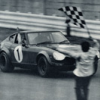
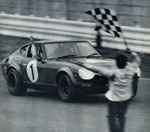
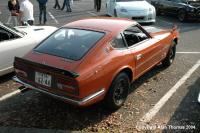
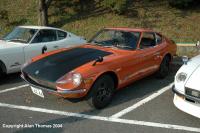
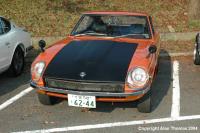
Hi Marty, If you saw a Fairlady Z432-R in a Nissan showroom in 1970, you'd be able to recognise it from the following: First of all you'd probably see a 918 Orange paint job, as all the 432Rs sold to the general public were apparently in the one no-option colour. Next you'd notice the anti-glare satin black FRP bonnet / hood, and the smooth all-chrome bumpers with no rubber trims and no trim holes. You should see plain steel wheels with no hubcaps ( the magnesium Kobe Seiko wheels standard on the 432 were an extra-cost option on the 432-R ) and a plain clear glass, untinted, windscreen / windshield. You should also see a satin black FRP rear spoiler - the ribbed type ( for extra sensitivity... ) - sitting on the tailgate. No badging other than 'Fairlady Z' and '432' ( and perhaps an oblong 'Nissan' emblem on the rear spoiler ), and there was no 'R' type badging or emblems. A side stripe kit might have been fitted. Look a little closer and you'd see that the door window, quarter and tailgate glass was actually lightweight acrylic with a 'Nissan' heatstamped logo in the corners. Some - but perhaps not all - 432Rs had an FRP tailgate, with no gas strut ( just a steel rod prop ). Look around underneath and you'd see a full-length FRP undercover for the engine bay at the front ( the front valance subtly shaped, and with captive nuts, to accommodate it ), and the 100 litre fuel tank in the rear ( to homologate the 100 litre tank for JAF-sanctioned GT class endurance racing ). The front grille should be subtly different to the standard Fairlady Z / Z-L / 432 item, with a finer mesh. Peering inside, you would see the spare wheel perched on the rear deck area ( the spare wheel well having been deleted to make way for that 100 litre fuel tank ) and a pair of hopsack weave fabric-covered FRP bucket seats ( manufactured by office furniture maker Ikeda Bussan ), and probably only the driver's seat would have a bolt-on headrest with a black vinyl cover. You should also see a Takata four-point safety harness on each seat. Had the new owner specified it - and paid the extra cost - a leather-covered 'Mach' three spoke steering wheel might be present, but if not then the standard Izumi pressure-moulded wood composite wheel. The plain black moulded urethane / rubber mats on the floor would sit on plain painted metal with no sound-deadening material on it. The diamond quilted vinyl interior covering - as seen on other S30-series models of the same period - would have no sound-deadening / insulating material under it either, although the trans tunnel cover would be plain unquilted vinyl. A thin urethane / rubber mat would sit on the rear cargo area. The firewall should have no sound-deadening mat on it either. The dash would look a bit bare, as stock 432-Rs had a blanking plate in place of the clock. Standard 432-Rs would often have no glovebox lid and no heater / fan - although some buyers paid extra for them to be fitted. Proper 432-Rs would have no radio and no antenna. You'd see just one sunvisor ( for the driver ) and no day/night feature for the rear-view mirror, and no centre console. There would be no ignition key barrel on the steering column, as it was re-located to a bracket just in front of the gearstick ( to make it easier to reach when strapped in by the four-point safety harness ). Door panels should have simple woven nylon pull straps instead of arm rest / door pulls. Looking in the engine bay, you should see no air box on the Mikuni 40PHH carbs ( just steel trumpets ) and no air filter box on the radiator support panel. You'd see an oil cooler standing in front of the ( aluminium ) radiator. You should see no brake booster either, as it was deleted to save weight and give better pedal feel through a brake pedal with a different pivot ratio to other models. You would not be able to see those lightweight body pressings ( made from one gauge thinner steel than stock ) but they'd be there. Apart from all that, it would be the same as the PS30 Fairlady Z432 standing next to it in the showroom... That's the theory anyway. In practice it seems that there was some subtle variation in specs, and that buyers either specced the cars with a few extras ( heater / demister, glovebox, mag wheels ) or added them soon after buying. Many cars will have been modified down the years ( one 432-R even ended up with a G-nose... ) but the trend these days is to bring them back to a period-correct spec. I'm sure to have forgotten something, but that's all I can think of off the top of my head. I find the cars fascinating, and I'm always learning new things about them. Cheers, Alan T.
-
If you have a few minutes to spare, please take a look at our fellow forum member take432r's Gallery photos: take432r Gallery - Classic Zcar Club Photo Gallery 'take432r' is Takeuchi san from Japan, and his genuine PS30-SB 'Fairlady Z432-R' has been the star of many Japanese classic car magazine features. Takeuchi san has been refreshing the car recently, and has been adding some very interesting and informative photos to the above gallery. Please take the time to have a look at them, as they reveal many of the 432-R's subtle differences from the 'normal' 432, and of course all other S30-series Z cars. It's a rare treat to see a genuine 432-R in pieces... The 'super lightweight' PS30-SB is the rarest of S30-series production models, and certainly the most valuable today. 'Less Is More' certainly applies here, and the 'PZR' ( in factory jargon ) hides many of its unique features - such as its super-lightweight body with thinner gauge panel pressings, whilst many others are not immediately apparent - such as its acrylic windows and 100 litre fuel tank, until you start looking a little more closely. I've seen this car in the metal ( and plastic! ) several times in Japan, and it's one of the few S30-series Zs that I seriously covet. It's lovely. Cheers, Alan T.
-
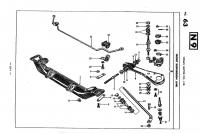
I'm talking about the C30-series Laurel, of course. If you really want to comb through and look for clues ( it's fun! ), I can send you the factory parts manual for the C30 as a PDF.... But my point is that it's daft to call the "350/370 Z Car" ( Z33 / Z34 actually.... ) a "shortened Infiniti" if you still think the ( shout it ) "DATSUN 240Z" is some kind of virgin-pure engineering Year Zero creation and you have little or no idea about the cars that were alongside it in the design / drawing offices or on the production line, let alone alongside it on the showroom floor. Platform sharing is the modern way. It doesn't make the Z33 or Z34 any less of a car. Here's a peek at one page from the 1968 C30 Laurel parts manual. This one's a well-known engineering design share:
-
 Hello Takeuchi san, レストレーションうまく行くといいですね。頑張って! Alan T.
-
Perhaps a reminder of the thread title and the following quote from the first post is in order: The S30 is not all about the "DATSUN 240Z", however loud you shout it.... Japanese market S30-series Z threshold plates ( 'PLATE - kicking, sill outer' ) had no lettering on them whatsoever, and they certainly qualify for this thread.
-
....whilst you're still in denial that you own a Laurel Sport.
-
I'd rather trust Nissan, thanks. As has been discussed so many times before on this forum, there's almost nothing on the early Z cars that was Cadmium plated. Almost everything that was plated was Zinc plated, and the characteristic 'yellow gold' of many nuts, bolts fasteners, brackets and other nick-nacks is simply a passivated finish added after Zinc plating. From Nissan technical manuals: 亜鉛 ( 'A-en' ) = Zinc.
-
No offence to you or the vendor, but I would suggest that unless you are dealing direct with Nishi san from 'Revive Jalopy' in Japan then your 'vendor' is very unlikely to have been dealing with the OEM material manufacturer / supplier. One observation I would make is that I've seen both gold and silver backgrounds on Nissan maintenance stickers, depending on the application and period of manufacture. I've also seen all sorts of patination / discolouration which - over a 40 year odd period - can make such stickers look very different to how they must have looked when new. I would trust MikeB's example for the manufacture date period he has shown.
-
It's not a GTP car. It's an R90CK ( Lola chassis ) with the VRH35Z V8 turbo engine from the 1990 Le Mans 24hrs. Specifically, the JECS 'sponsored' #25 car of Donnelly / Brancatelli / Acheson. It had qualified 5th, but DNF'd due to terminal transmission trouble.
-
Yeah. Maybe it's in Japan too...? He's got me on his 'Ignore' list, obviously.
-
It's actually a works PA10 Violet on the 1980 East African Safari Rally. Specifically, the no.10 car of Rauno Aaltonen and Lofty Drews, which finished in second place behind the sister no.1 car of Shekhar Mehta and Mike Doughty.
-
Well, many of the images you've been posting have obviously been right-clicked-and-saved from elsewhere. So this guy is simply getting them from the internet ( I can tell you that he most certainly does NOT own the copyright to the many of them ) and is putting them on the picture-only thread that you're sourcing them from, but divorced from their original source and context. What a waste. So where is this mystery forum and mystery thread you're getting them from? Is there no conversation about car, driver, event, date, photographer whatsoever....? Is it just eye candy....?
-
Only if you count 1976 as "recent". That's the car that Andre Haller died in whilst competing in the 1976 Le Mans 24hrs race. We've discussed it several times on this forum in the past. How come you're 'finding' just so many photos that you don't seem to know anything about? Don't any of your sources list the relevant data? If not, why not? Is it because they are just endlessly right-clicking-and-saving and then re-posting elsewhere without taking any notice of the context? It's as though pages are being torn out of books, thrown on a big pile and then reassembled in random order.
-
How about considering the effects on supply before demand? The 1973 Arab-Israeli 'Yom Kippur War' and the OPEC oil embargo that followed it caused huge disruption in Japanese manufacturing and the Japanese economy as a whole. As Japan imported all of its oil, the embargo had massive implications for Japanese industry. That period became known as the 'Oil Shock' in Japan, and its effects lasted for many years beyond the initial events. Looks like we have the beginnings of a similar situation in the same region again today....
-
There are misconceptions about everything, though. Try telling people that "240Z" means more than one thing and they look at you funny. Same with "260Z". There's '260Zs' and there's '260Zs'.... There certainly were basic power differences for what appeared to be similar engines, depending on the period and the market. It may not be as much as the OP hoped - or as little as you think - but for sure there were differences in camshafts, compression ratios, ignition timing / timing curves and carburation, and that's before we start talking about any anti-pollution gear being hung on them. Like-for-like, year-for-year, I think you'll find that the 'Euro' market models will always have had more power than north American market models. Maybe not much, but worth noting.
-
That's the old Fourways Engineering 'Bluezmobile' Modsports racer, here in the UK. Now in new ownership, but Fourways are still involved in prepping / running it. Many of the panels are alloy, and it has some interesting mods. Fast car. How come you seem to find so many photos that have been separated from their original source?

-
It's a UK market car, as can be seen from the Road Fund License 'Tax Disc' attached to the windscreen. The license plate is a 'personal' plate, transferred from an earlier ( pre-February 1963 ) registered vehicle, and has no age-identifying suffix or prefix letter. Such numbers can be purchased from the UK licensing authorities, and transferred from car to car by the owner. This car would have been issued with a three letter, three number, one suffix letter registration plate when it was first registered in the UK in 1971,72, 73 or maybe even as late as 1974. The siffix letter would have been K, L, M or N.
-
Very interesting, thanks. However, it kind of confirms what I have mentioned previously: If you were to view a video like that on it's own, you could be forgiven for believing that Nissan had put ALL of their race operations in the hands of NPTI and were doing precisely nothing in house, or even elsewhere. But in fact, nothing could have been further from the truth. The NPTI setup was one part of a global racing setup that Nissan had running at that point. Quite bittersweet to see the P35 mentioned at the end ( much promised, little delivered ) but it's a perfect illustration of what I'm talking about...
-
Thanks John, but would they not have been called 'Datsun Competition ( USA )' at that point? Shirley 'Nissan Motorsports USA' was a later iteration that post-dated these parts, unless they are not as old as I'm imagining...? Whenever I see the name 'Nissan Motorsports' I think of Japan, and the works competition departments at Oppama, Murayama and Omori which would eventually become 'NISMO' ( their Telex address ) in 1982.
-
For reference, here's a photo of an AMPCO E4621 Nissan 'Sports Option' gas-filled front strut. Note the screw near the top where the unit was filled with gas, the full-size spring mount and the short portion of thread for height adjustment / corner weighting:

-
Darren, I don't think that's a Nissan Motorsports setup, I think it's a period local fabrication. Here's why: The 'coilover' type factory 'Sports Option' struts almost invariably used full-size springs that sat on wide alloy bases, with slots cut in them for tightening. Yours have smaller diameter ( 2.25" / 2.5"? ) springs, sitting on small platforms that have holes drilled for fastening. The threaded portions on your struts are about twice as long as the factory type too. They also appear to be welded all around the threaded portion, whereas the factory type only had short welded sections on them. The camber-adjustable top mounts on your setup are also different than the type Nissan used. The high-angularity uniball sandwiched into a two-half alloy housing is similar to the system the factory used, but they used an offset centre for their - limited - camber adjustment, and the camber was adjusted by turning the complete top mount whilst yours appear to be linear adjustable. However, the damper inserts themselves look just like the heavy duty Nissan Sports Option inserts - although they appear to be the oil-filled type rather than the gas-filled ones. Do you see any part numbers on them? If you can, I might be able to give you the bump & rebound data on them. The whole thing looks like a period-correct setup of good quality. I note the long wheel studs, drilled rear brake backplates and ( what appear to be ) modified steering knuckles too, but stock front discs. A competent race shop build from the early Seventies, perhaps? Something from a C-Production SCCA racer maybe? Hope that helps. Alan T.
-
I think you're mis-diagnosing the problem, and mis-identifying these "rubbers". What you are calling "rubber O-rings" are in fact felt washers which were designed to hold lubricating grease / oil for the eyeball joints in the linkage. If you replace them with rubber o-rings they will not lubricate the joints and will actually slow down your linkage through the drag they will create. I recommend you dismantle the whole linkage and pay extra attention to cleaning out the alloy castings that the wiper spindles pass through ( they have grease traps inside them, very likely fuull of solidified gunge now ) as this is where most of the stiction occurs, as well as washing out the eyeball joints with thinner or fuel, and re-greasing them. If you can't find replacement felt washers, you can cut some yourself from a suitable material. Soak or pack them in grease before fitting. Should work a lot better afterwards.
-
Look out Fred, Carl wants to tell you that your Fairlady Z-L is "irrelevant" in person......