HS30-H
Supporting Member
-
Joined
-
Last visited
Everything posted by HS30-H
-
......or how about we discuss the whole family of Nissan's 'L-gata' engine series, rather than starting out with the mistaken preconception that the "L16/L24" was some kind of Big Bang from whence everything else evolved? What a strange thing to write. Hiroshi Iida was the head of the design team that produced all of the Nissan 'L-gata module' engines up to early 1968, including the first L20, the L20A, L23, L24, L13, L14 and L16 - which led to all the other versions of this engine line that continued on well into the 1980s and beyond. What's with the "take the word of the man", and mentioning just the L20? I think you're playing games already........ First of all Carl, I must say that it is quite amusing to see you apparently taking this article seriously, as when we first starting discussing it on this forum you appeared to be completely writing off its contents - and the testament of Hiroshi Iida - without having even seen it. I don't want to be rude to the "professional source" who translated the article from Japanese into English for you ( as I know how hard true translation - in the real sense of the word - can be ), but it seems quite clear that they are not all that familiar with the terms used in automotive engineering. For example, I'm wondering quite what the "....several others who read/write both Japanese and English....." who checked the translation of the article for you made of Iida san's "cold water" ( sic ) engine design study? Did none of them suggest that it be corrected to 'water cooled'? I could go on, but I think any native English speaker who reads the translation you commissioned will understand the point I am making. You make it sound as though this is an unimpeachable professional translation ( to back up its gravitas, no doubt ) whereas I say - quite objectively - that it is written in Japanese-style English with something less than a full understanding of the techical subject that it relates to. I also note that the translation misses off a chunk of text. What happened there? Was it surplus the requirements? Yes, journalists can be very sloppy. We know that. So can the authors of web sites. So too can the likes of you and I be sloppy, and misunderstandings are human nature. However, I don't see how you can be pointing the finger at Mr Manabu KUMANO when your own understanding of the topic is so young. Your writings on zhome.com still say that the design of Nissan's L-series engines came directly from Prince - which is quite clearly erroneous. And I also notice that you have put the translation of the Nostalgic Hero article on a zhome.com-addressed ghost web page without the courtesy to mention the original author Kumano san's name. Nice. I don't understand this. You now want the names of the men working in 'Engine Design Team 1', and you specifically mention the L16? Surely you are missing the point of the whole topic? Who are you asking these new questions to, and why did you not ask them before now? Are these the people that told you that the Nissan L-series six design was acquired by Nissan after the merger with Prince ( as seen on zhome.com )? Why are you singling out the L16 unless you are trying to reinforce your long-stated misconception that all of Nissan's 'L-Gata' / 'L-Series' engines grew from Katayama's claim to have 'ordered' an engine 'suitable for the USA'? I'm afraid that this stance owes more to Creationist theory than logical Darwinian explanations. Why do you insist on singling out the L16 and L24 from the rest of the family, and pointing to them as though they are L-series Genesis? I believe that you are looking for scraps of thread that you will attempt to sew together into a tapestry that depicts the L16 as the Adam and Eve of Nissan L-series engines, giving birth to that "All New" L24 ( "for the USA" ), and completely ignoring the big picture. That's not scholarly or even logical. It's worthy of a prize from the Flat Earth Society. I presume that - once you have got a name to pin the 'L16' design on - you will move on to vaunt him as Lord Creator and totally expunge Iida san's name from your specialised branch of "Datsun" history? Ah - now we are really getting down to the nitty-gritty, aren't we? So basically, you want to take what you want to believe from the interview, and disregard the plain fact that Iida san, Nissan and indeed Kumano san all saw Nissan's L-series engines as a family that had several generations which had their root in that design brief of creating an answer to Toyota's new six cylinder engine for the Crown in 1964. You insist on drawing a hard line between that first Nissan L20 six and everything else that was either designed alongside it or followed on from it - when in actual fact the whole article ( and Nissan's own corporate history ) makes it clear that this was a family with shared DNA. I believe the only reason you do this is because you grew up with NMC USA's Pol Pot-style 'Year Zero' policy press releases and internal 'newspeak' - which made a studied point of ignoring what was going on in Japan. All that and you actually have the brass neck to question Kumano san's "perceptions", and imply that he 'simply misunderstands' the subject? Just amazing. Or alternatively, I believe that Mr Beck says that this is what he understands from the writings of a journalist who quite possibly has his own 'perceptions', and may 'simply misunderstand' what Mr Iida told him - and that Mr Iida may not have understood what he was doing anyway. That's pretty much what you have been alluding to above, isn't it? You now go on to write out what you want to take from all this. To wit: No. You already misunderstand. Iida san was assigned to Engine Design Team 2 ( with responsibility to 'Mid Class Capacity' engines, including the Cedric and others, and also large truck engines ) when he returned to Nissan from secondment at Hitachi. This was not in July 1964! You are already misunderstanding the translation that you commissioned. The date of July 1964 relates to the design brief to come up with a new engine for the H130-series Cedric, which was some time after Iida was installed in Engine Design Team 2. Again, I see what you are reading into this. You want to make mileage out of that 'Bluebird division' vs 'Cedric division' thing, as though the two teams would be in competition with eachother and not consulting / sharing resources and ideas. You are disappearing up a cul-de-sac when the road signs quite clearly tell you otherwise. Are you not - again - missing the whole point of what is written? The nuance - quite clear from the article in its original Japanese - is that getting such a new engine to market in such a short space of time was a huge achievement. It allowed Nissan to give an answer to arch-rival Toyota's new six cylinder engine for the flagship Crown model. They started off on the back foot, but caught up due to the hard work of Iida and his team - working round the clock, and testing the new engine in the dyno room for ten hours at a time for twenty days - after coming up with a running pre-production prototype just four months after starting the project........ You're reading-in negativity when the whole point is that they did well. Yes, there were problems in the first production engines - notably in valve stem seals ( soon improved ) and oil control rings on the pistons ( also cured by changing to a different design of ring ), but many problems were overcome on the test bed and well before production release. Why the negative spin, which is not a true 'translation' of the feeling and spirit of the original Japanese article? Again, you are reading just what you want to hear into this. Yes, Iida san makes the point that they were able to start with block casting data that already existed ( for obvious reasons ), but this is not really any different than referring to a book of cosines and tangents rather than working them out for yourself each time you need one, is it? The point being made is that they started design on the new engine quickly because they used design data from a block style that already existed. Don't confuse the mention of a 4 cylinder 'L' engine ( meaning a generic Longitudinal configuration ) with the name given to the L20 six, and the rest of the Nissan 'L-gata / L-series' range that shared its DNA. You misconstrue the meaning of the point being made about 'sixes from fours' in the original Japanese text. Iida san was alluding to the fact that at that time all Nissan's small and medium capacity engine data and know-how ( aside from truck, marine and stationary engines ) was in four-cylinder engines. When they started drawing and laying out the new six they utilised this existed know how rather than starting from nowhere. That is logical and natural. It should not be misunderstood to mean - in any practical sense - that the new L20 six was 'based on' an existing four-cylinder engine, or that they 'added on' two cylinders to make a six from a four. Why would you want to pursue that train of thought unless you wanted to - perversely - rewrite history to match what was nothing more than an advertising blurb? Iida san admits - rather candidly I think - that he and his team "referred" to the Mercedes OHC six design with respect to the valvetrain design for the new engine. He does not say that they simply copied it ( neither does he state baldly and somewhat flippantly - as you have done above - that they "used the M/B OHC design" as if it was a blatant copy - as if they had then surely MB would have had something to say about it ) and it is clear that they had a good look at Prince's G7 engine too, some details of which were apparently properly licensed from MB. Nothing is created in a vacuum, after all. Iida san seems to be quite open in acknowledging his team's influences. Why are you making so much mileage out of the initial problems they had - even when many of them were cured before production? Is it part of your attempt to draw that line between the L20 six and the L16/L24, as though the L16/L24 were some kind of immaculate conceptions? It is quite obvious that the L16 and L24 ( and all the other variants in the family ) benefitted from the problem solving on the first engines, and were the better for it. That's the big picture that is quite clear from the spirit of the article. Ah - here we are getting to the bottom of your Creationist-style theory. Now you again want to highlight that L16, as though the L13 and L14 never existed and talking as though the L20 six - which was being updated and improved simultaneously with all the other L-series variants - had stopped dead in the water. It had not! This is the whole point: It was a continuous process of evolution that was going on here. You point to the L16 as being a "better design" once again as though it was made on another planet to all the others ( you fail to mention above the L13 - which kind of puts your skewed perspective in a nutshell, as it is quite clearly mentioned in the original text and even in your commissioned translation ) and bend the story to suit. Nonsense! Once again you misunderstand the translation you commissioned - let alone the original Japanese text. Iida san was the chief of the team that designed all of those early 'L-gata' engines, and their design and development was being led by what they went through to get the H130 Cedric Special Six's engine into production. If you can't see this for yourself then at least I hope others will see it, and recognise that this was a homogenous effort that naturally included both basic engine design teams. Where did he mention the 'L16' on it's own? That's your line! But you can't have your cake and eat it. Of course the later engines were the result of an extensive design and development cycle - but you seem to want to draw a line between them and all that went before. That's quite clearly an error. The fours and later sixes were all the result of the testing, development and production refinements of the earlier sixes. Iida and Nissan themselves make this very clear. Do you honestly think that they just threw all that data and experience out of the window and decided to start again? A quick look at the layout of the engines would show that this was clearly not what they did. The only major change to the core design was the change in bore spacing - a refinement that allowed a bigger range of capacities to suit both domestic and export requirements. The later ( let's say late 1968-on ) engines were clearly developments of the earlier designs rather than the pure clean-slate designs you want to portray them as. You are quite correct that the L16 was not developed by "removing two cylinders from the L20" ( who on earth thinks that this represents any kind of practical description of engineering method? ), as the whole point is that the L16 - and its brothers and sisters - were drawn up alongside the L20, and by the same people. They DID utilise the L20 as a 'base design' from which others grew ( the whole article makes that very point! ) and drawing an arbitrary line anywhere in the sequence of events with the sole intention of proving some kind of immaculate conception following on from a Katayama quote is positively absurd.........
-
There were lots of changes in the 'L20' six engines from 1964 through 1969, and there was no single design change that differentiated an 'L20' six from an 'L20A'. The reason for adding the 'A' suffix was to differentiate the six cylinder engine from the new four cylinder engine when capacity was two litres - hence 'L20A' and 'L20B'. Of course, if you prefer to swallow NMC USA corporate and advertising mumbo jumbo whole then you might be happy to believe that the L24 was an "ALL NEW!" design based on the "JUST FOR YOU" L16, but "WITH TWO ADDED CYLINDERS"........... Erick240: Keep the head and cam that came on the engine originally. If you want more performance, modify the ports slightly for better flow, increase compression slightly and consider changing carbs and exhaust. If you want to change the camshaft, go for an aftermarket item rather than another stock factory piece, as no stock factory camshaft is different enough to justify the swap. And don't try putting L20A parts onto an L20B. Some of them won't fit!
-
As discussed a few times on this forum in the past ( and in personal correspondence with Mike Cammerata ), quite a lot of that is just plain wrong. I thought zhome.com was carrying an updated and corrected article now?
-
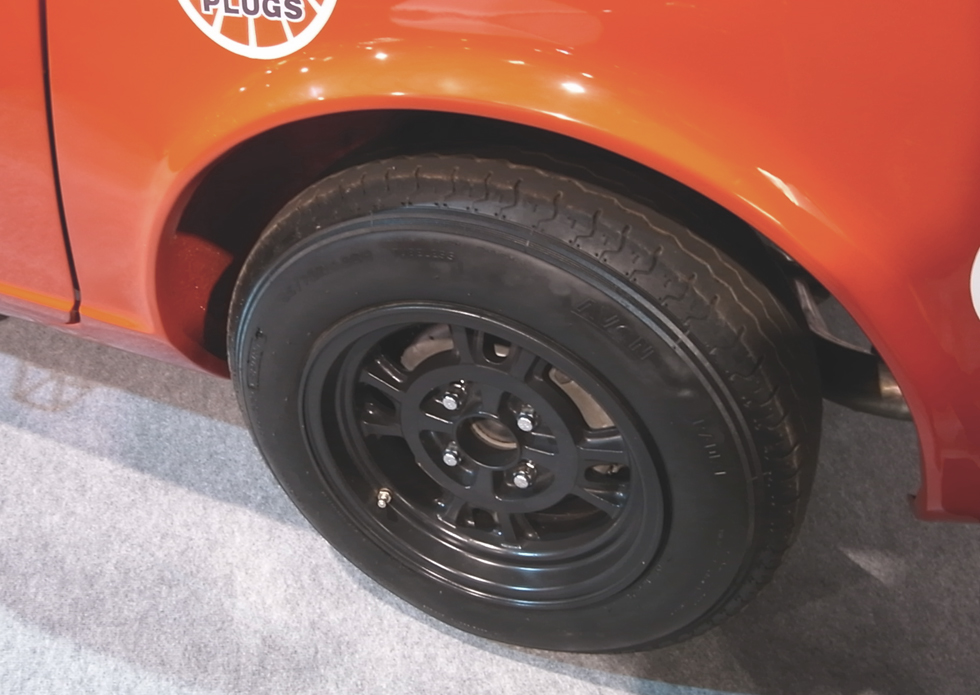
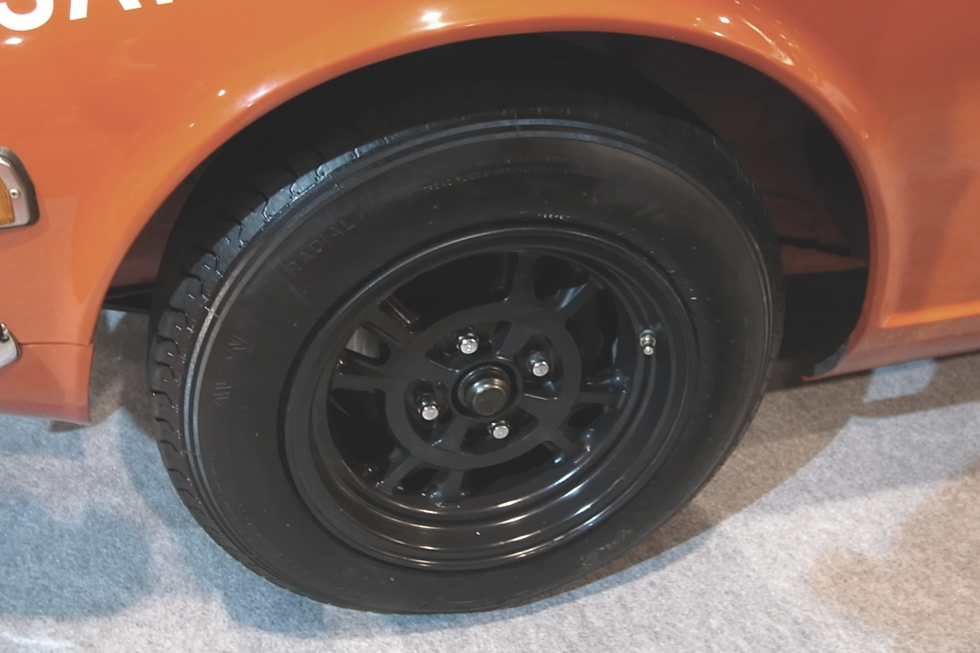
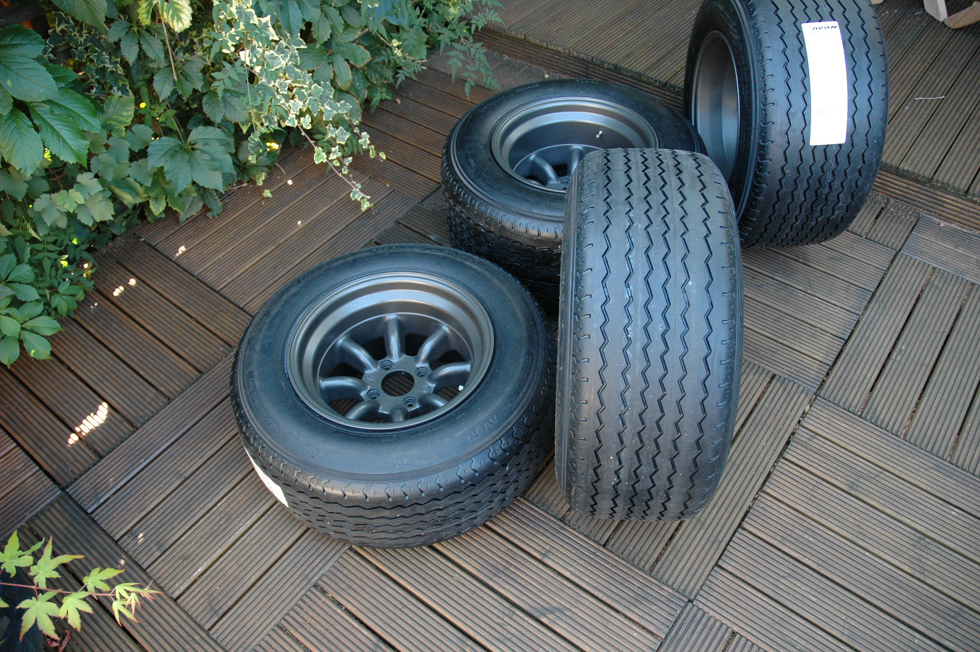
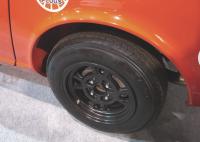
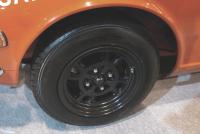
Sorry for the late reply. They are 245/60-R15 on 9.5j x 15 and 295/50-R15 on 11j x 15. Fred, here are some pics of the 185/70-R14 Avon CR6ZZ on 7j wheels. I don't think that they look particularly 'stretched', and the sidewall still extends out beyond the rim of the wheel. They should still work OK on your 7.5j. I recommend that you order direct from BMTR, and ask them to make a quote ( and ask for some discount! ) before you place your order.
-
jerz, Welcome from a fellow south-east Englander here. I'd like to compliment you on the shut lines of your car, which looks like a really good one. In my opinion, the UK market RS30 models are some of the nicest all-round packages in the whole S30 range, and make excellent all-round road cars. Pretty rare too. Those Hitachi carbs are subtly different to those seen in other export markets, and don't really deserve half of the bad rap that they get by association. I believe RIP260Z is crusading on their behalf. Last time I visited him he had a couple of sets on his living room table! Cheers, Alan T.
-
OK Doug, I'll settle for that. It's nearly as good as "Surely one of the best collections of HLS30Us in the world". That would be both an honour and a pleasure. Certainly on my 'Must See' list should I ever make it over to that side of the Atlantic. Has anybody here seen all the Z collections in the world? Without having travelled a fair bit around 'The World', and gained access to some of the very private collections that exist, I can't imagine anyone would be gauche enough to suggest that they'd seen 'THE Best'. Surely such superlatives are subjective anyway? At the risk of flogging a dead horse, I'll make the point once again that these are Japanese cars we are talking about here. Different models and sub-variants were sold across a pretty wide part of the globe, and they were raced on a number of different continents. In my mind, a 'Z Mecca' worthy of that description would need to represent as many of those models, variants and factory race and rally cars as possible. Meanwhile, back in reality, such a collection seems fairly likely to be impossible - more's the pity. :bulb: So - for all practical purposes - maybe the most realistic candidate for our own little 'Z Mecca' could actually be here, on this forum........? :bulb: Alan T.
-
Yes, I agree ( of course ). I'm not advocating the fashion of 'stretch', but needs must, as the saying goes....... And to be honest this amount of 'stretch', and with these particular tyres, is not really as extreme as you can see on a lot of modified cars in Europe these days. Take a look at the photo I posted. Do those tyres look stretched to the extreme - or indeed dangerous - to you? The rim widths there are 9.5j and 11j, and the tyres fitted are not as wide as the 'approved' sizes...... Fred, I told you they were a bit expensive! But with tyres you get what you pay for. They are one of the most important components of your car, and it is not worth cutting corners as far as quality is concerned. You might be able to find a Chinese tyre in the 'right' size, but most of them are absolute junk and there's a point of view that they are downright dangerous in their low levels of performance. Japan has a much better choice of tyres for this kind of wheel on this kind of car. Some of the Japanese Dunlops are superb, but they are often not 'E' marked, and therefore are technically illegal to use on European roads. You can use them of course, but vehicle inspectors and insurance assessors are starting to take notice of this kind of thing lately, and it's a good excuse for them to avoid a payout..........
-
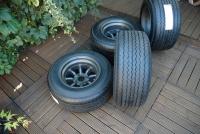
Yes, I've used them. Excellent tyres. Very stiff sidewalls - well suited to 'historic' type suspension systems. Here are some ( 15 inch ) that I've had on the GT-R:
-
I'd recommend AVON CR6ZZ in 185/70R-14. Basically a road-legal ( 'E' marked ) historic tarmac rally tyre, and absolutely superb on the road. They'll stretch onto your 7.5j wheels OK, and won't look silly. You'd be surprised. Bit expensive though..........
-
You certainly outfoxed me by talking about four parts in a pair of headlamp covers. In my mind, that's either two or....er.....lots ( if you count the foam rubber seals, the mounting plates and all those little screws....... ). All covered by two Nissan part numbers, in two boxes. Tricksy question! On the 'Price per Pound' question for hard stock parts ( as opposed to repro stickers or one-off sales of rare plastic doo-dads ) I was going to nominate the painful personal experience of an S20 water pump assembly, at 170,000 JPY retail ( ouch ). Made all the more painful by the total of around 22% taxes and import duties levied on the cost of the part and the cost of the postage ( double ouch ).
-
Certainly not a conventional dry sump pan with that depth..... and it has no 'trap door' sections like you'd see on a race-oriented wet sump with that amount of capacity. Marine application, possibly?
-
This could be fun. You've certainly got me scratching my head. I can't think of anything that could be so light at 4-off, and also make the car faster. Parts in multiples of four make me think of corners of the car ( wheels, brakes, suspension components? ) rather than anything engine related. What on earth can be so light and have a noticeable effect on speed? I'm stumped. I can think of a few silly-price candidates in the Price-per-Pound question though - even if I might have to go metric on weight. NOS Stopwatch Clock oscillator units, PZ tachometers and factory Sports Option 'Mach' steering wheels are all fairly light, but change hands for alarming amounts of money. This could go anywhere.....
-
"I'm not going to argue unless you pay......." But seriously, it is a pretty lofty claim isn't it? Might be safer to take a leaf out of Carlsberg's book, and add "Probably......." In other news, the small island of Fraggle Rock has just had a cultural boost with the opening of it's new 'Charles D!ckens Heritage Library'. However, amongst the praise and fanfares a small voice of concern was heard. How come the library consisted of just twelve copies of Oliver Twist, and one of Pickwick Papers...........? :classic:
-
No disrespect, but how would you even begin to justify such a lofty claim? And surely "nicest" is such a subjective term as to be almost meaningless in this context?
-
You should have consulted a Kindergarten teacher. Then you would have got the right answer.
-
Hey, that's really creative! You should be in the business of making films about the "Dartsun Zee Car" for the Schmistory Channel. Oh I'm sure Ms. Gable was present when 'Pinin' Farina and Katayama were talking about the S30-series Z, but - let's make no mistake about this - the shape of the car was the work of Yoshihiko Matsuo and his team in Japan. It didn't come out of Katayama's office, and Pininfarina had nothing to do with it ( apart, of course, from being one of Matsuo and his team's many subliminal influences and inspirations ). If she's referring specifically to the front-end treatment of the 240ZG model ( and the parts therein ) and therefore after the basic S30-series front end had been penned and produced, then that would be erroneous too. Matsuo himself penned the design of the ZG front end - initially in response to requests from Nissan's race department - due to the necessity of homologating such a model. It had nothing to do with Katayama, or Pininfarina. I've talked with Matsuo at length about this, so I have it from a good source. With all due respect to Ms Gable, I think she is misunderstanding the significance of what she witnessed. I can't recall where I heard it, but I remember hearing ( and being very surprised ) that Ms. Gable had absolutely no idea whom Yoshihiko Matsuo was until at least the 1990s, and that she originally believed Katayama had "designed the 240Z"...........
-
Ah, the Katayama "...personally chiselled them off....." Fairlady emblem story, and the Johnnie Gable "..... I was there when they were designing it....." Katayama & 'Pinin' Farina story. Aaaaaaaaargh :ogre:
-
conedodger, You seem to be determined to carry this on, and you appear to be focussed more on this question of who is - or is not - being "rude" than on understanding the real problem ( bad data ). Perhaps you might find a little enlightenment if you spent some time looking at the archives here, with the emphasis on exchanges that have been taking place since around 2002 ( six years or so before you joined ). I don't think you'll make a very good referee for a virtual boxing match if you only get into the ring in the eleventh round. Let me remind you that you brought the question of my nationality up, sir. Only you will really know your intentions in doing so. But having brought that subject up, you now question its relevance? Where exactly were you trying to go with that? If you don't see it now then I don't know how I can make it any more clear to you. The data on the zhome.com page in question was plain wrong. The author ignores queries as to its accuracy, and instead calls into question the accuracy of a website that is far more specialised in the subject than his own. Then the data on zhome.com is "updated" - but it is still misleading. Call this to the author's attention and people seem more interested in questioning the intentions of the person bringing the matter up than in making sure the data is correct and reliable. Why is "it" so important to me? Are you kidding? You mention that you work in "Academia" ( congratulations ) and then you want me to explain to you why accurate and reliable data is important........? Quite extraordinary.
-
'conedodger', Thanks for your advice. Nice of "Academia" to come and pay me a personal visit, and useful to know that "....the English argue differently" when posting on what is actually an international forum. I'm afraid I shall be sticking with my opinion ( obviously differing from yours ), and I think that's healthy as far as this forum goes. Otherwise we might as well rename it the 'Carl Beck Fan Club' and let it become the replacement for his dearly departed Mailing List, in which he was able to edit all posts before they even hit the screen. I see you are damning the racingsportscars.com site too. Quite extraordinary. You and Mr B. could be two peas in a pod. If the data on the ex-Speakman car at zhome.com was originally right, then why has it now been "updated"? And if what is written on that page now ( implying that the Doyle, Speakman & Maffucci 16th O/A finish in 1978 was the first finish for a 240Z at the Daytona 24hrs ) is correct, then please post your evidence to prove that the other cars we have mentioned don't count. And if you have any other 'advice' for me on how to deal with your friends, then please send it to me by PM. Thanks.
-
It has already been pointed out that there were 240Zs that finished the race in 1975 ( the Mabrito & Steel car in a pretty good 26th O/A and 8th in GT-U at 420 laps, and the Buzbee, Ross & Frates car 32nd O/A and 9th in GT-U), and 1976 ( Frates, Ross & Buzbee again at 38th O/A and 15th in GTU at 274 laps, whilst Mabrito & Steel got a DNF with 47th O/A, 18th in GTU and 185 laps ). So why does the zhome.com page on the ex-Speakman car read that it ".... was the first Datsun 240Z to finish the 24 Hours of Daytona....."? At the very least this is misleading, and fairly disrespectful of the efforts of the '75 and '76 entrants - which were arguably blazing a trail for others to follow. That 16th place O/A in 1978 was a fine achievement, but surely everybody can see that the zhome.com page is now worded misleadingly after previously simply being........ wrong? Well, respect is a two-way street, isn't it? I think I'm giving around the same amount of respect as I'm being given, to be honest. It's not a two-way dialogue, is it? Unless you spotted a post that I can't see? Further back in this thread you'll see Carl Beck calling into question the data published on racingsportscars.com ( a well-researched and well-respected site ) when it is his own site that carries the errors in question. That page in question wrong for over seven years - misleading people that I have personally had to correct - and then it is "updated" rather than simply being corrected....... I guess you must see it all quite differently.
-
Would it help if somebody explained it to you?
-
Page "Updated 28 Feb. 2009", and reads: "In 1978, Bob Speakman's Z was the first Datsun 240Z to finish the 24 Hours of Daytona, finishing 16th over-all and 4th in the GT-U Class." So it's still wrong.....
-
Are you missing the point again? On this page: http://www2.zhome.com:81/History/Bork.htm It says: "In 1975, Bob Speakman's Z was the first Datsun 240Z to finish the 24 Hours of Daytona, finishing 4th over-all." ........which is wrong. And why do you keep calling him "Speckman"?
-
Are you seriously questioning the data at racingsportscars.com? That's a very well known and respected site, and I think the data there is very much more likely to be right than something that you added to your site because somebody might have given it to you "....off the top of his head."
-
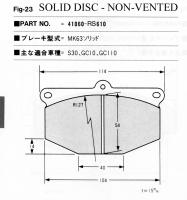
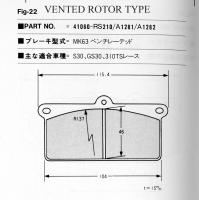
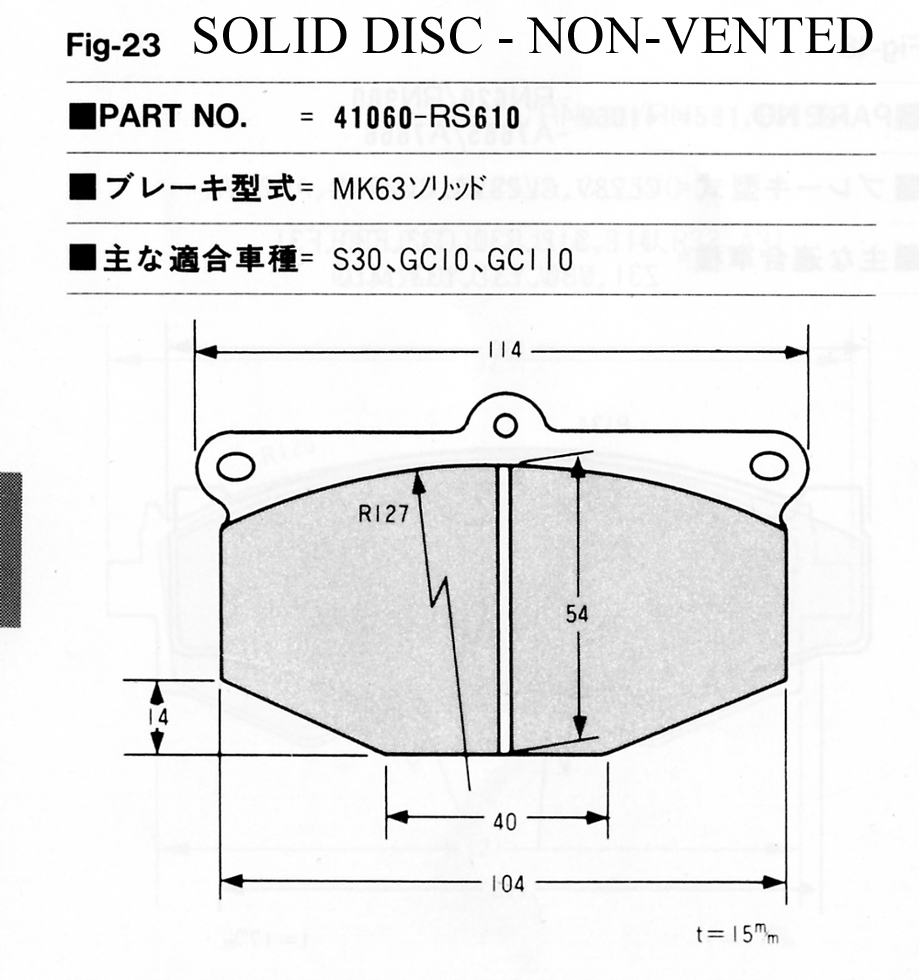
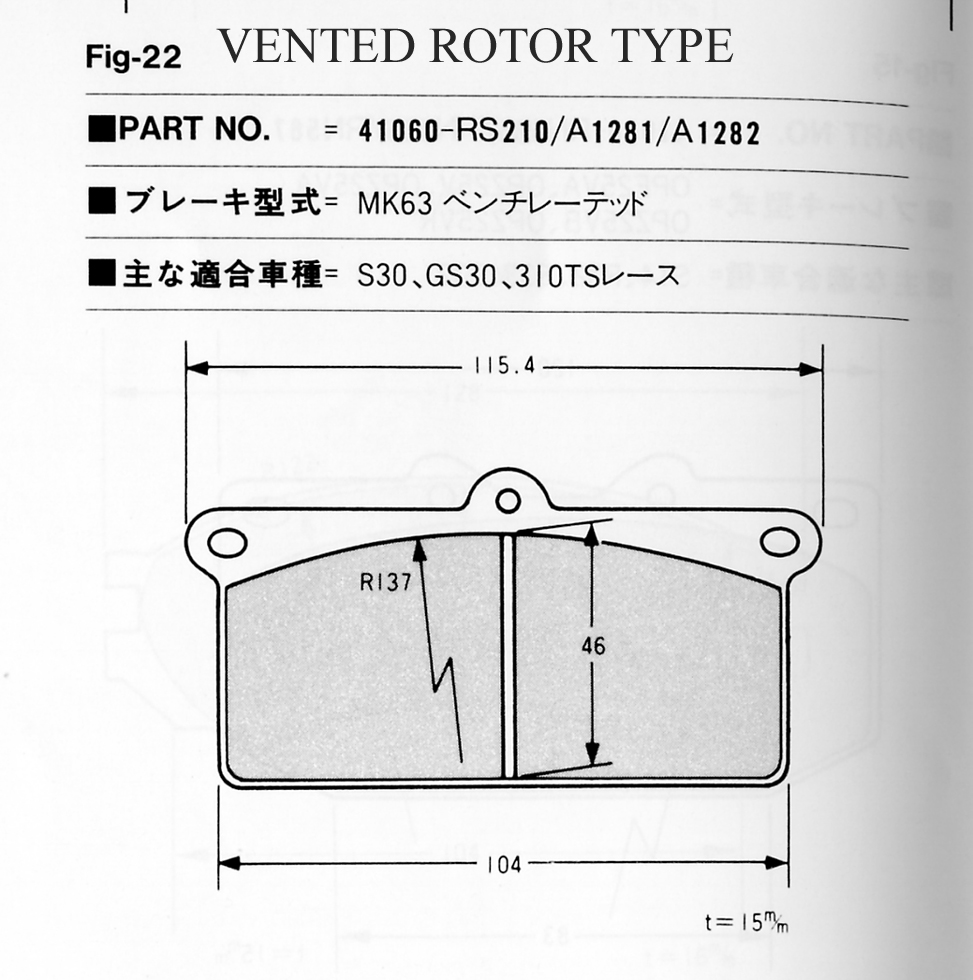
It's fairly easy to get pads for the vented rotor version of the MK63 in Japan ( Rubber Soul, Victory 50, Kameari, PitRoad, RS Start and others all stock them), but the solid disc non-vented type - a different pad shape - are more difficult. You might try asking for 41060-RS610 with an Australian NISMO dealer ( that's a NISMO part number for the M59S friction material version of the non-vented MK63 ) but it's likely they will have to import them specially. I use ENDLESS pads on my MK63s ( three cars ) and they are really good, but I don't believe they have a 'stock' pad for the non-vented version and they would likely need to be made to special order. Using the pad dimensions in the diagrams below, you might like to try asking an Australian brake specialist if they have anything close. I seem to remember that there is a UK Ford caliper ( 3 litre Capri and Granada? ) that used similar pads that can be modified to suit.....