LeonV
Community Member
-
Joined
-
Last visited
Everything posted by LeonV
-
That doesn't look normal to me. Although the picture may be deceiving my eyes, it looks like your rear wheels are toed in excessively. I don't know if the bushings have enough slop to cause that. If your rears are truly toed in, I'd look for bent parts or incorrect installation.
-
Seriously? He's a danger on the roads for letting someone know that they have a taillight out? I don't follow. That's one of the most idiotic things I've heard. Nice attitude. Wave a gun at everyone, that makes it all better. What's with all the pent up rage?
-
Yes, that's how it came from the factory.
-
Coop, you indicate that the difference between your Reno and Laguna Seca is about 14% so I'd expect the differences between Reno and Sac to be less. I'll use your link for an example. Looking at current (8am) Reno conditions (24 degF, 30.18 inHg, 71% humidity), assuming 4500 ft elevation, your density altitude is just below 3000 feet. If a 100 degree Sacramento day is 2700 ft density altitude then there is not much of a difference here! Back to my original point, you may not have to change much, if anything, at all. Climatic swings affect carb settings just as much as a change in altitude does, so there is no need to worry unless you make a really big change in altitude and/or climate. With that said, getting your initial tune done right is a whole different story!
-
This is exactly what I was going to say, so thanks Steve! Most parts interchange with either a 240Z or 280Z. There are plenty of free resources available to cross-reference and find the part you need. I love my early 260Z, it has a certain quirkiness to it which I enjoy. Plus, it has the nicer 280Z interior but the lower weight and electrical simplicity of the 240Z.
-
That's very good advice, coop!
-
Brainfart on my part on the WBO2. What I am saying is that your tune is affected by the climate of the area you're in, not just the elevation. I'm not saying that you must constantly tune for each condition. You have moved from one climate (and elevation) to another and you're curious as to how the jetting may change. The point I am making is that you should consider the average climatic differences between Sacramento and Reno, not instantaneous ones. You did go up in elevation which would make your mixture richer, but let's just say (making things up here) that on average Reno is 10 degrees cooler and more humid than Sacramento during driving hours. This would dictate jetting the carbs richer, all else held constant. This is why it's hard to say whether it should be richer, leaner, or stay the same. The only way to really know what to change, if anything, is comparing data-logs from your WBO2 from Sacramento and Reno. The more sample days the better. You're right in that corrected dyno numbers will be lower (aside: interesting comparison with the 914 since that's about the % difference in air pressure!). Dyno results are usually normalized ("corrected") to a standard temperature, pressure, and humidity (we've essentially covered why this is necessary, reference the link above for more). What the dyno actually measures is assuredly different! Therefore, dyno numbers are a red herring, since temperature and pressure variations have been taken into account when the data is presented to you. You have use of a WBO2, so you are your best source of information regarding the jetting changes that must be made to your engine. Nobody can answer that question better than yourself, especially since you don't even have to guess with the wideband. Relying on heresay, "he did this, I did that" is a lot less effective, and more time consuming. If your engine runs fine and you get similar gas mileage then don't worry, all is fine! Since you've just installed the wideband, it makes comparisons difficult as you don't have anything to compare to. Get the AFR where you need it in the weather that you typically drive in and you'll be set. I'm just saying that it's not exclusively elevation that will dictate what that WB says and what jets you'll ultimately settle for. Day-to-day changes in temperature, pressure, and humidity can make notable differences in AFR that you may as well leave the carbs alone if the AFR is "close" to where you want it and everything is running right. How "close" depends on your discretion, which is controlled by your knowledge of the subject at hand. That was the intent of my original post. That's a beautiful Z! I would love to hang out in the garage although I seldom make it out to Sac and can't say that I've been to Reno!
-
I'll take responsibility for that mistake, as I was reiterating what others have said to work and haven't done it myself. Didn't know there was a difference in shifters between early and late 4-speeds as all my Zs have been 5-speeds. Will the later 4-speed shifter not work? Many have said that swapping the shifters works, is there another one that can be swapped and will work?
-
Swap shifters from the 4-speed to the 5-speed and there will be no cutting required.
-
I'm a bit confused as you initially said that you disagreed with me, but then your statements agreed with me. You can manipulate a carburetor to do whatever you want it to do, it's just up to the end user to take advantage of that fact. Yes, air pressure decreases as you go up in elevation, thus you will run richer with all other variables held constant. This is one factor that goes into carburetor jetting, and fueling an internal combustion engine in general. Many EFI systems use a MAP (Manifold Air Pressure) sensor to correct fueling for air pressure changes. Here is where you contradicted yourself: you stated that you don't dispute the effects of weather and even gave an example why it's so! Temperature is a major factor in engine fueling. Air gets denser as temperature drops, and this is why you'll find that engines "like" cooler air. Cooler air means denser air, which means more air is entering the engine, and thus more fuel can be burned along with it. More air+fuel equals more power. I wholly disagree that you cannot utilize this for carb tuning purposes. A car that lives in a cooler climate will be jetted richer when compared to one that lives in a hotter climate. This is the reason why modern fuel injection systems use IAT (Intake Air Temp) sensors. Your point about water injection brings up the reason for humidity being a factor. By utilizing water injection you are changing the relative humidity of the air coming into your engine! More humid air means a cooler charge by way of evaporative cooling. This effect is a secondary one when compared to air temperature, but it is still there, especially as evidenced with water injection. More humid air means a cooler charge, which leans the mixture for a given amount of fuel. Thus, your engine will possibly be rich at 4500, but not necessarily. I don't know how it is in Reno, but I do know that Sacramento gets hot as hell in the summer. If your carbs were tuned during the Sacramento summer, then your mixture will be leaner at colder temps. Combine this with your now-increased altitude which makes you mixture richer, and it's not necessarily clear as to what changes must be made. There is a reason why I asked whether you were actually having a problem with your carbs or not! If it drives the same and gets similar gas mileage then nothing needs to be changed in the way of jetting. I assume you don't have a wideband O2 sensor installed, because that will show you how dramatically the mixture can change with varying conditions, even without changing your altitude. However, it seems as though your "butt dyno" has already shown how much temperature changes can affect engine performance! FYI, the true stoichiometric (not magic...) air-fuel ratio for E10 gasoline is about 14.2:1, not 14.7:1. FWIW, Leon
-
You'll probably have to lean it out just a bit, if at all. I'm willing to bet that seasonal swings in temperature, humidity, and air pressure have a more drastic effect on the carbs than just going up in elevation. Make considerations moreso for the climate that you're in, instead of purely elevation. e.g. If you're higher in elevation, and it's hotter and more humid, then you'll want leaner jets. Are you having problems with your carbs?
-
It's not going to make a huge difference, but it'll feel a bit more torquey especially off the line. If I were you, I wouldn't go through the effort unless the current diff is on its way out. A 3.9 or higher and/or an LSD will be more "bang for the buck".
-
The 300ZX LSD was a 3.7, however, Greg correctly states that the differential in question is in fact open (not LSD). Yes, it is from a '79 ZX. It came in the 5-speed coupe and 2+2. Look for a more detailed list on differential ratios at zhome.com; atlanticz.ca may have it as well.
-
-
-
Well said.
-
This is so awesome, great job!
-
Check the FSM, download it for free at xenons30.com.
-
We've already discussed the chain topic, within this thread! The timing chain is not the problem, forget about it. If anything, a slightly worn chain will retard the timing, which would give you a mild improvement in high rpm performance. Advancing the chain to the next position will advance valve timing and move your powerband down, meaning more low end torque as doradox states.
-
Excessive camber and fiberglass rear quarters equals big collision, in my book.
-
Your issue is fuel starvation, and it's very likely that the dirty tank clogged your filters. I would replace all fuel filters you have in the system (by the tank, in electric pump if you have one, in engine bay, and at the carb banjos). Again, for those having problems, correct valve lash is absolutely critical. It does not take much effort to remove a valve cover and measure clearances, yet it has a huge effect on the way your engine behaves. Filters first, valves second, then worry about the rest. If your car will rev to redline occasionally, but bogs at constant speed then the problem is exactly what you would think it is, no magic to it.
-
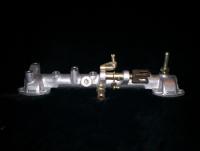
I just took a look at ZTherapy's site. Here is what they say about their balance tube: Here is their photo (PCV valve front and center): You must have the crankcase breather hose attached to the PCV valve. Otherwise, you have a giant vacuum leak in your intake making you run very lean.
-
Ok, so the problem from the original post has been partially fixed, correct? I really doubt that ZT would plug the PCV hole (why?), are you 100% sure that there is no hose coming from the block breather that attaches to the bottom of your balance tube as the FSM depicts? If there isn't then check to make sure that you don't have a huge, gaping hole or a PCV valve sitting all by itself in the bottom of your balance tube. If everything checks out, I would move on to valve lash. Check it hot. If that checks out, then make your way to the carbs and make sure the needles are installed properly. If they are, then put in a good set of stock needles and see if anything changes.
-
All cars sold in the USA since about 1968 had to have a PCV system. Refer to page EC-2 of the 240Z FSM. You've figured out the problem with the "colortune", but here's the thing with round top SUs: you can't adjust the idle mixture without changing the AFR in the rest of its dynamic range. By leaning out the mixture to look good at idle, you have leaned it out off-idle as well. We'll see if making the mixture richer will help, and if turning the knob doesn't work I would take the carb pistons out and inspect needle installation. A wideband O2 sensor is the only good method for finding out what is really going on in your engine.
-
If you don't care then you can do whatever you want... If you're talking about making an engine run as best as it can (this so called "tuning"), then that's another deal altogether. I'm really curious to see the dyno sheet of the 20hp gain that a header alone got you. Can you post the dyno sheet to substantiate your claims? Okay, the key word here is "seem". This does not quantify anything whatsoever. The EGR valve should always be inspected and replaced if it's malfunctioning. A malfunctioning EGR valve or broken parts is the only reason why an engine would operate better without the EGR system in place.