



Zed Head
Community Member
-
Joined
-
Last visited
Everything posted by Zed Head
-
I would confirm that you have a problem first. "Engine spinning fast" doesn't tell much. Check cylinder pressure, or pull the valve cover and check your valves and keepers. Check the cam position at TDC via the notch and groove. Might not be a chain issue at all.
-
The top one looks closest but still doesn't look like the thermotime switch (not sensor). It looks more like the CHTS, which BGM linked to. I have both, the thermotime switch is squared off and one piece, while the CHTS has the tapered tip and is two piece. You shouldn't have a CHTS unless you have a ZX engine. The thermotime switch will measure ~60 ohms through the two pins when cold. When it's hot it will open up.
-
Are you sure that the original one from your 71 won't work? Odds are fair that it might. You might have to remove the dust cover. When you said "yoke" I thought that you meant just the piece that slips on to the trans shaft and has the u-joint in it. Some people call it the slip yoke. You're asking for the whole front half of a two piece drive shaft. I don't think that they exist for a 240Z. Someone out here has the answer.
-
I misread the transmission part number. Thought you were modifying a newer transmission, from a 300Zx or 240SX, which also would require the older 70-71 shorter drive shaft. I think that any of the yokes up to mid-74 might work. Late 74 or 75 is when they went to the staked u-joints. Anyway, good luck with it.
-
Your dash ammeter will give a good indication of whether or not the alternator is charging. + means charging, - means discharging (running off of battery power). This would be while the engine is running, when the key is off it should be in the middle. Car batteries don't like to be fully discharged, it's not good for them. It's also not good for the alternator to charge a completely dead battery. You might have a bad battery damaging your alternators. And, as Steve implies, if you haven't rewired the car for the internally regulated alternator things won't work right. Also, for the record, the ZX alternator is probably 60 amps, not 70. The 280ZXT's (turbos) came with 70 amp alternators but they're not available anymore. The parts stores replace them with 60 amp alts. If you're no good with wiring, and find that your battery is bad, you might be best off having the old external reg alternator tested and, if it's good, getting a new external regulator. One option.
-
-
You know more than I do. I missed the monitoring function. I thought it was like the coolant temperature sensor, just off and on. Didn't know the EFI ECU was that sophisticated. Maybe it just needs a good Italian tune-up.
-
Thought you had the ECCS since you said "blinking". I don't think that the EFI system is "monitored" periodically like the ECCS appears to do. I think that the EFI lamp only glows when the O2 sensor is hot and the O2 level is above or below the narrow band threshold. That's why the FSM has you ground the sensor connector while watching the lamp. That mimics hot and either lean or rich (can't remember which) condition. If you ground the O2 connector and the light glows, then disconnect it and it goes out, that means the harness and ECU circuit are O.K. The lamp probably doesn't go on during normal usage until the manifold is hot and the lean or rich condition is met. Just a guess, I have a 76 with no O2 sensor. Hopefully I'm not confusing things.
-
Weird, you must have found it through Google or some other link. If you try just Web Page Under Construction it doesn't work. Pretty basic stuff though, hard to go wrong unless you adjust the spring when it doesn't need it. On the blinking light: Are you not trusting what the FSM says? Page EF&EC 47 > if "N.G." (no blinking light), test the O2 sensor and the harness. Did you do the tests on page 48?
-
Nothing will work right if you don't have the right fuel pressure. I'm not familiar with any AFM rebuild procedures and the kamikaze link is "under construction". The insulators are there for vibration and heat insulation. The smaller o-rings at the bottom are vacuum seals for the intake manifold. The cracked insulators won't affect the way the engine runs. I would check fuel pressure and flow before going too much further.
-
Is the gear assembly sticking out sideways or straight up? Maybe the shafts are hanging from the gear set weight and causing misalignment. It's pretty easy to stick the front case back on though and find out what will happen in use. I would do that anyway without sealant just to make sure things are right. I had one on and off several times and wished I hadn't been so confident with the sealant. Had to clean it up and start over. Don't forget to put it in to gear before putting the front case on or you'll probably lock it up when it goes in to two gears at once.
-
Something off with the shift fork? Apparently they can bend or crack without breaking completely. The roll pins holding the fork on can shear also, maybe yours is halfway there. The fork might be directional also. Have you seen duragg's rebuild opus on Hybridz? Might make you want to spend a little more time on it before you put it back in. High RPM shifting dynamics - Drivetrain - HybridZ
-
The thread title recalls a scene from a popular old movie -
-
Don't forget the cannoli...
-
I figured that a professional running a restoration businesswould be all over having an official factory source for information. It's kind of surprising that you asked. You'll still need the FSM to get the numbers you really need, the thickness of the disc facing material. Unless Dr. Z opens up the FSM again and gets some more for you.
-
Are you sure it's not electrical? You could check for voltage drop to see if something is grounding the injectors. Or you could disconnect the injector electricals, repressurize the rail and look for pressure drop. If it's mechanical they'll leak down, electrical, they'll hold. The stock filter should reject most of any crud, and a bit of water since the element is paper. It would be odd for new injectors to crap out so soon. I have a set of original 1978 280Z injectors from a car that sat dead for ten years, that flow-tested on my home made tester within a couple percentage points of each other. Ran great on the engine.
-
It's in the FSM.
-
The length of the CV shafts for the conversion has been discussed to death (death of the stock CV shafts) on Hybridz.com. One of the guys who determined that the stock Z31 turbo shafts were too long, and made up a bunch of shafts to the correct length, just posted in another thread in this forum. Edit - in short, what I'm saying is that I think that you can find all of the answers on the Hybridz.com site. The adjustable control arms are discussed, the bushings for the different ring gear bolt sizes (10 or 12 mm), and the lengths of the axles. There's also information on avoiding certain CV shafts because they are way too long (I can't remember which ones right now). The shafts that would probably work for you, with the T3 arms adjusted wider, are the 4 bolt Z31 turbo axles. I think that the Z31 VLSD axles are too long, longer than the Z31 4 volt CLSD axles, that might be where your problem is. The information is spread around though so it will take some searching and reading.
-
-
Problems like yours are common on Hybridz.com, have you been over there? - Drivetrain - HybridZ You will take some heat though, for swapping a CLSD for a VLSD, if you post a question on Hybridz. You could have run the stock u-joint half-shafts with the CLSD, using 280Z companion flanges in the diff, although there might have been some binding at certain points of the suspension travel. - Beta Motorsports, LLC Bench Racing
-
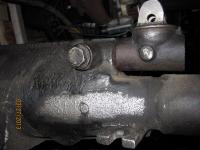
Here's a picture. It has numbers but I can't easily figure them out. Different from yours. Apparently scratched in to the sand before pouring, maybe, since it's raised on the part. Or engraved in to the mold for the investment the sand is packed around,. No metal-casting expert, so could be way off, just guessing. Notice the big vent or sprue chunk in the picture though, missing from yours.
-
I have a 78 5 speed with the two exhaust hangers and the tall shifter ears. I've noticed the shifter ears on mine and wondered. I decided that the shifter ear thing as an identifier was incorrect. The shifter itself is the same as my 76 4 speed shifter and fits fine, no interference. My 76 4 speed has the access plate and the 78 5 speed does not. Both transmissions came in cars I bought and didn't show any signs of being replacements. Measuring the 5th gear ratio is a pretty good way of telling the late from early 5 speeds. .864 for the early and .745 for the late, with a .773 thrown in the middle, late 80 to early 81 I believe.
-
I had pondered the turbo timer but discounted it since it was typically a delayed off timer for the ignition, and they appeared to be very expensive (over $100 by a Google search). You're right though, it could be activated with a simple push-button momentary switch, or always working with an ignition circuit.. I'm new to EBay. Looks like the $20 EBay units are all from China or Hong Kong. Worth some more research, for sure. Edit - I'm not sure any of them run for 20 minutes either. Can't tell. Most of the ads seem to be selling blue or red LED colors as the main feature. Edit 2 - what kind of timer did you use on the Jag? Was it one of the $20 EBay jobs? They look a little iffy to me.
-
It's hideous, especially compared to some of the nice engine bays shown on this forum. I must decline. There are only three main parts - the ZX fuel rail cooler blower fan (zip-tied at this point in time to my AC system drier bottle on the passenger fender well), the pre-heat hose (similar to that linked in a previous post) with holes that you can't see underneath, and the flexible piece from the ZX cooling system to connect the hose to the blower (probably not necessary). The rest is a fuse holder, some wire, and the timer zip-tied to the steering column. There is room under the fuel rail that is ready-made to slip the tube in to. The bilge blower I linked to in Post #6, from BGM's suggestion, would probably work as well as the ZX blower. Still a little bulky but probably easier to mount.
-
Thanks for the tip. I searched that number though and got a 24 hour timer. Like you'd use to set a sprinkler system or lights. The Amazon listing says it's 120 volts also. Intermatic E1220 Timer, 24 HR TIMER W/TOG SW PLT - Amazon.com