
Captain Obvious
Community Member
-
Joined
-
Last visited
Everything posted by Captain Obvious
-
The cold start spray is in addition to the normal injector squirting. Both the regular injectors and the CSV will spray at the same time if the engine is cold enough. So, I got a question.... When you say it won't start without a spray of starter fluid, how long are you cranking it for before saying it "won't start"? Reason I ask is that I removed my cold start valve completely and it definitely takes longer to start without it than it did before I took it off. Maybe five seconds of cranking? I'm wondering if you just are giving up too soon. What happens if you crank the engine for fifteen seconds straight? Sounds like a short amount of cranking, but with your hand on the key, it doesn't feel like a short time.
-
That's cool! Thanks for sharing.
-
RIP Mr. George. I'm sure he's sipping a drink at the Commodore Hotel on the other side.
-
I don't know off the top of my head, but I'll check when I get a chance. I can tell you that it's a straight thread, and not a taper thread. I suspect that will complicate your project a little.
-
You mean like Feats Don't Fail Me Now?
-
I'm no pro, but I'll weigh in anyway and say "Wow". That is definitely in the same league as my busted cam tower alignment. I'm wondering if the last guy tried to press the seat in with the head cold and that's all the farther he could get it in. Gave up and just dug the grinding in extra deep to account for it. That's pretty bad. So it looks like the thin lip around the edge broke off along the side opposite the companion valve? Is that the case? Sure hoping it broke off during the seat cutting operation and not after the head was put into service!! Any dents on the piston top from pieces getting knocked around in there? If that's the only issue, your machinist should be able to take care of that pretty easy. If he says the rest of the head is good, then I'd stick with it. If he skims the head clean, you'll be at .010 to .015 (ten to fifteen thousandths) off stock. I don't think any of the other components (like the timing chain) will care about that small of a change.
-
I think you're going to love it. We should all wear our Foose dew rags to the next event. Bunch of nerds....
-
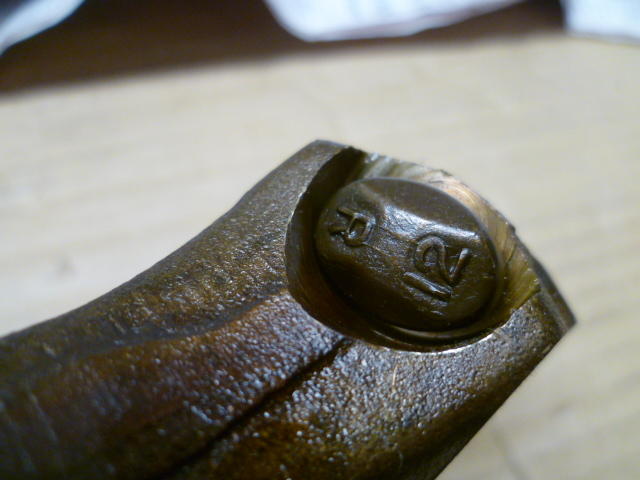
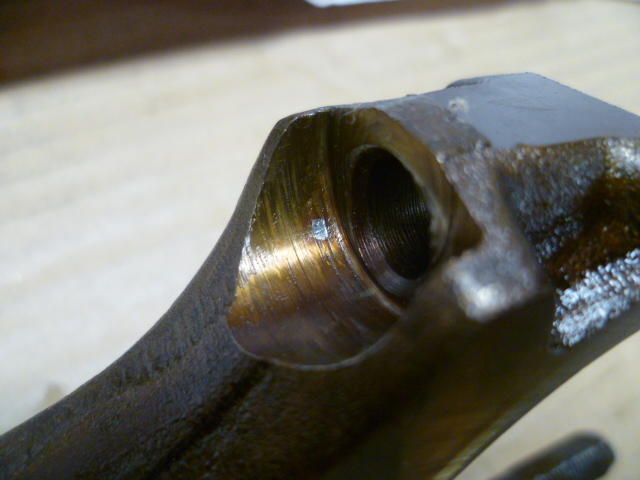
@Av8ferg, Last page you were talking about rod bolt positioning... I was messing around with my pistons a little today and I came up with what I believe is a reliable witness mark for the rod bolts rotational position. During installation of the rod bolts and nuts, it's the oval shaped head of the bolt that keeps the bolt from turning while you tighten the nut on the other side of the bearing cap. Because of this feature, the oval bolt head contacts the rod in one spot as the night is tightened, and (on my pistons at least), this resulted in clean spot witness marks where the two were in contact with each other. Here's some pics. During tightening, the bolt head will rotate in the recess in the bore in the direction of the tightening torque applied. Looks like this: And because of this, there's a little clean spot on the connecting rod where the bolt oval made contact: And a corresponding clean spot on the oval bolt head: It's pretty small and you might need some magnification to find it, but if yours look like mine, you should be able to use these marks to determine the original rotational position of the bolts. Assuming you've got the original bolts in the original holes, this should allow for positive ID for original rotation.

-
Woof. That amount of consumption ought to be pretty easy to find. Have you run a compression test? We talked about it a little before and I mentioned that I'm getting a little oil burning and blue smoke on my broken cam engine, but it's at nuisance level... I've got a thousand miles on it and the smell is annoying, but the consumption rate isn't high enough for me to do anything about it. One quart in 150 miles would have more of my attention. Stuck or broken ring?
-
Hoover FTW!!
-
I'm here! Thanks for covering for me!
-
Oh no! I guess when it rains, huh? I'm sorry to hear about the multiple calamities. I don't know how to estimate what the change will be to chamber volume with a .015 shave. Are you going to measure the volume, or just guess a reduction amount?
-
You sure are "lucky"! Hope that's the last issue!!
-
Wow. Down to the tendons pulling a valve cover!! Glad you got it all stitched up! You didn't have to drive yourself to the ER did you? I'm assuming you got a bunch of dirty "You idiot, not again!!??" looks at home, didn't you? I know I would.
-
Based on some prior super-secret discussions with @wheee!, I'm running a Denso 150-2066. I've switched pretty much everything over to Denso now.

-
I think that timing cover is fine. Those little lines are just imperfections from the original casting. I see you already sanded them off. Good... Non-problem. As for the hex plugs in the intake manifold... As mentioned above, they cast a cavity that runs the length of the manifold to distribute the recirculated gasses from the exhaust (EGR). But that cavity does not have any connection up to the intake runners because it was impossible to cast that way. So those plugged holes are the access holes they used to add in the holes between the shared EGR log and the individual intake runners. I haven't pulled those plugs or sectioned a manifold to see for sure, but I wouldn't be surprised if the holes they drilled up into the runners are different lengths depending on how far they are from the EGR valve. Just a guess on my part. In any event, they drilled small access holes up into the runners and then tapped and plugged the access holes below. And they thread-locked the steel hex plugs in place. I tried to take one out as well and couldn't get it out. I suspect a bunch of heat would make them easier to get out, but I was doing this on the car. Next to the fuel rail.
-
-
-
Haha! Yeah, that could go either way! And you might not want to know which way. I wonder if you had welding beads flying all around enough that you got one stuck to a valve guide... Who knows where else they landed??
-
Haha! Yes, black with yellow. not white. Sorry. That's what I get for relying on memory. Glad I got the starter location correct at least. Pull that small black with the yellow stripe off and then turn your key to START. You should hear the fuel pump run.
-
I'm not far from Strafford. And that's not too far from Devo either. LOL!
-
Disconnect the small black wire with a white stripe. Should be a spade connector, and it should just pull off. No tools required. Don't let the dangling B/W wire short to anything. Put a piece of tape over it if you aren't confident.
-
Uhhhhh... That's not the starter. The starter is the other big electric thing behind you below the battery.
-
Absolutely. If you travel to the Northeast, make sure I know about it!
-
No, I haven't taken any measurements off mine. I know I popped two of them out enough that they could have spun 180 degrees. I don't know for sure if they really did spin or not. And the two that popped out far enough that they could have spun were not on the same piston. So I know with certainty that both bolts are in their original positions on four pistons and at least one of the two bolts are correct on the other two pistons. That's all I got right now. I ain't skeeered. Haha!!