Phred
Community Member
-
Joined
-
Last visited
Everything posted by Phred
-
clutchdust, The difference in C.R. between the L-24 & L-26 is only .3 (three tenths). Not worth fussing over. The reason the L-26 has more HP is simply a result of larger displacement, and a cam with 8 degrees more duration. To my knowledge all 260's came with the E-88 head. Which also came on the later 240's. The early 240's came with a E-31 head which had less cc's in the chamber. If you surface the E-88 head .020 you will gain a half a point (.5) of compression. If you do this, make sure to have a three angle valve job done at the same time. The extra compression won't do anything unless you can get the valves to flow a little better too. If you do all of this plus a good header & exhaust, make sure to run some SM needles in the carbs. At that point, I'd be interested to see some chassis dyno numbers, before doing anything else. Phred
-
Get the head Gasket to fit the block you have. I don't know what years the F-54 was produced, (80 to 83?). I have the same F-54 - E88 setup, and while its not assembled yet, its a perfect match. I have built several engines in the past with this combo, and always used the Nissan 11044-N4221 head gasket Phred
-
ZmeFly, Hang in there buddy. The one thing we all have in common is we're all on the same road. Some are just going to get there a little sooner than others. I lost my Mom five years ago. But I was able to spend the day with my Dad, who's 86 & has had three heart attacks. So I know whats coming. Hard not to be sad. But I chose to be happy, Good memories are something that won't die. Phred
-
2manyZs, I built and dyno'd several 240 ITS engines, and the most I ever saw was 172. This was on a SuperFlow computer control dyno. This particular engine won the Oregon Region Championship. I'm sure other engine builders have gotten more HP out of the L24. Up here in the Northwest we have what we call California Horsepower. Someone comes up from Ca. and says his dyno shows 185 HP. Then gets pulled down the straight by one with 170. This was similar with the formala ford engines. We would build one with 114 hp, go to the runoffs and pull a guy down the straight who claimed to have 118. In all fairness, dyno's in different parts of the country use different correction factors. Thats why you should not get too optimistic when you hear someone throw out some big HP numbers. Dyno's are great tuning tools, and give you a good reference point on how a particular engine is going to work. But its all relative. If you get beat down the straight, you need more! Phred
-
SteveK, Good post, I agree. Matt, The only other unanswered question you had was about ITA. The Sports Car Club of America, SCCA, is the major sanctioning group for road racing in the U.S. A group of classes is called Improved Touring. Broken down into individual classes A, B, C, and S. So ITS is where Zcars race. The rules are very restrictive as far as the allowed modifications. Basically, stock components must be used in the engine, but you can balance, adjust cam timimg, ign timimg, and carb tune as well as run headers. So these engines represent the peak HP that can be had with a stock engine. Phred
-
I dyno'd a fresh L-24 That was ITS prepped. It had 165 HP at the flywheel, and it was a front runner. Without headwork, cam, and other trinkets, you won't see 200 HP from a L-24. Phred
-
boltmans, I used to build L-28 GT-2 engines. The by-pass was removed, and the by-pass port pluged. Dry sump systems were used, which produce more pressure and volume than a stock pump. Different types of remote filters were used. None had a problem with blown seals. However, many had tank heaters, and all ran synthetic oil which is thinner and easy to pump when cold. Its been a while, but I think ITS rules don't allow dry sump sustems. So if you plug the by-pass on a stock system, that stops the oil from completing its circut. The way I see it, you would have to enlarge, and tap the by-pass port for a fitting to run to a remote, non by-pass type filter. Then run the return line back to the center pressure in port of the block filter boss. Would that be ITS legal? Theres a few ITS racers on this site who will hopefully enlighten us. I havn't built one of those in few years, but oil still has to flow out of the block, through the filter & back in again. Phred
-
Clutchdust, You know, were all just a bunch of hotrodders who like the Z. One of the fun parts is doing your own thing with your own machine. Many of us have been down the same road your on, and we just don't want to see you loose your wallet along the way. Thats why most of these posts have advised you to drop in a L-28 till your ready for something big. The L-28 would be cheaper, and have more grunt than a bored out L-24. So, do your own thing, have fun, and let us know how it goes. Then, you can say to us ,"see, it worked", or we can say, "see, we told you so!". Merry Christmas Phred
-
clutchdust, I explained what comp. dist. is in my first post, go to the back of the class. Your last post indicated the the comp. dist. between the two pistons is .1mm. thats only .004 in. Insignificant. The displacement of an L-24 bored out 2mm would be 2507.2cc compared to 2394.6cc stock. Not 2700cc. The pistons are not interchangeable between the L-24 & L-26. Remember they have different strokes. Therefore the comp. dist. is shorter on the L-26 to keep the piston from popping out the top of the block at TDC. If you can operate a calculator, use these figures to compute displacement. 1mm= .03937 1 cubic inch= 16.387cc divide millimeters by 25.4 to get inches multiply inches by 25.4 to get millimeters Displacement: bore x bore x 16.387 x .7854 x stroke x # of cyls (bore and stroke figures entered in inches) I used to hate math in school, but it comes in handy now & then. Phred
-
Just a few things to consider. When the factory increased the L24 to an L26, They did it by increasing the stroke. The 24/26 have the same bore. The 26/28 use the same crank. They all rev quite freely, and when you put in a fat cam you loose bottom end. the increased stroke will help increase torque in the low to mid range which helps balance everything out. Summary: keep the stock bore plus .040. The extra cyl. wall thickness will help maintain strength and transfer heat. Run the L26 crank, rods, & pistons. Your first piston question: 83mm=3.267inches thats the actual diameter of the piston. The stock bore is 3.270, which gives you .003 pist/wall clearance. The question concerning rings: The available oversizes are .5mm, .75mm, .1mm, & 1.5mm. Referance: 1mm= .03937 inches (or .040 overbore) The other specs you mention as 2-2.0mm and 1-4.0mm indicates the ring set includes 2 rings which are 2mm thick which would be installed on the 1st and second grooves. The other being the oil ring which is 4mm thick. The compression distance you indicated as 38.2mm (1.503inches) is the distance from the centerline of the piston pin to the top of the piston. The factor that determins how much you can mill the block deck is the distance known as "piston to head clearance". as an example, if you had a "zero deck" meaning your pistons were even with the top of the block at TDC, your piston to head clearance would be the thickness of the compressed head gasket, which is around .043/.047 for a factory gasket. This is the minimum that should be considered. Or the piston might smack the head at high RPM. And that will spoil your day. Phred
-
Hi Ed, A street engine will benifit from a similar treatment as far as break in is conserned. Get it out on the back roads as soon as possible. Accelerate moderately through the gears, then let it coast down, and repeat. keep your eyes on the gauges, and take a look under hood frequently, to make sure all liquids are where there supposed to be. Try not to hold it at a steady rpm for at least a couple hundred miles. Run petrolium oil for at least the first 500 miles. I think the factory replacement rings use a chrome top ring and a cast iron second. Which is a very durable combo. The problem many people have when they do a home rebuild, is replacing the rings without honing the cylinders. You might as well just hit yourself in the head with a hammer. To properly seat in, a chrome ring needs a honed surface with the correct grit stone and cross hatch pattern. There are tools called ball hones which rough up the surface and leave a cross hatch pattern. This is needed to allow the ring to "lap" itself into the cyl. While the cross hatch will microscopically hold oil to keep things from galling. But the ball hone will not properly "size" the cyl. like a ridged Sunnen type hone will. A ball hone follows the exsisting bore, while the Sunnen type will actually resize the cylinder. which is preferred. Even if your cyl. is enlarged a few thou., Its much easier for the ring to follow a straight hole than one that is slightly tapered or out of round. So when replacing rings, wether on a street or a race engine, have it properly honed. And if its a race engine, hone it with a torque or deck plate installed. Phred
-
I have spent many years "breaking in" ( I hate that term) engines. The method actually varies depending on the state of tune or specs for a given engine. Probably 90% of these engines have been "run in" on an engine dyno, but the rest were run in on the track. First and most important is never let a new engine run at a constant speed without a load on it. Do not run it rich as stated in an earlier post. If these two things are combined, the rings will never have a chance to seat. The extra fuel will do nothing but wash down the cyl. wall and accelerate piston/cly. wear. Typically, on a dyno , the engine is partially loaded and run in the lower rpm range while it comes up to temp. Then its accelerated still under partial load while the timing is verified. The engine must be under load to take out all the "slack" in the drive components so the timimg will be stabilized and verified with a timing light. Being under load also causes the engine to produce more work, (torque) which creates heat and pressure within the cylinder. this pressure is what actually seats the rings. Most racing rings have very little "static pressure" which is the outward pressure the ring places against the cylinder wall at rest. When the engine is running, under load, the pressure in the cylinder is forced past the upper ring land and into the gap behind the ring. this extra pressure is what helps the ring to conform to the cylinder. At this point it is most important to note that synthetic oil is NOT to be used during engine break in. Especially with chrome rings. Synthetics are so good at lubricating, they will not allow the rings to seat into the cyl. After break in, change the oil and filter, and then put in the synthetic. If you have to break in your new engine on the track, an exhaust gas analizer or an EGT (exhaust gas temp.) gauge is very good insurance, and will keep you from burning down your nice new expensive race engine. As with the dyno, accelerate smoothly, then back off and let it breath. The more times you can do this the quicker the rings will seat. Rings come in many different sizes and alloys. The break in procedure for a 1/16 chrome ring will be much different from a 1mm steel or cast iron ring. Finally, if you can afford a race engine, you can afford to have it dyno'ed. It will be cheaper in the long run, produce more HP, and cause you less lost sleep. Phred
-
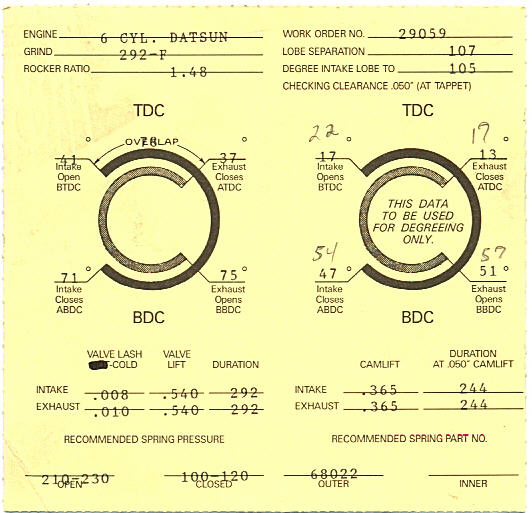
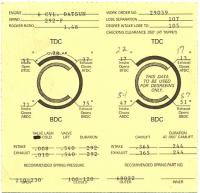
This one was direct from Schneider, don't know if its the same grind that MSA sells. But good for comparison. Phred
-
Atten. 2ManyZ's There is a formula I have around here someplace for computing throttle bore size. It uses displacement, RPM, and Volumetric effieciency, ( an educated guess unless actual #'s can be measured on a dyno) The RPM used is the max used in your particular application. which is tough to figure for a street car. The formula will give you the right size for say, 7000 RPM. But what about drivability at lower RPM. So, you have to use the SWAG method and experience to size carbs to an engine. An engine such as I'm building or the one Dreco has will produce more HP on the top end with 45's or 48's, but if you were to drive the same engine on the street, you'd need 40's to 45's to have some driveability in the lower RPM ranges. Thats why the 40's are so popular. but for best HP with high volumetric #'s. you need the carbs that will flow enough to match the capability of a prepared head and cam. That means bigger carbs. Also, the bigger carbs require proper jetting to get most out of them. Thats the great thing about Weber's ( or Mikiuni/Solex). You can adjust idle, main, and air jets, and choke size (venturi) all independently. For a race engine, this is critical to get max HP without damage from a lean condition. This is where the dyno is indespensible. Using fuel flow #'s and exhaust gas temp., proper jetting can be made quickly, or you can spend all day the track and still not get it right. Lots of things to consider, Thats what makes it fun. And expensive. Phred
-
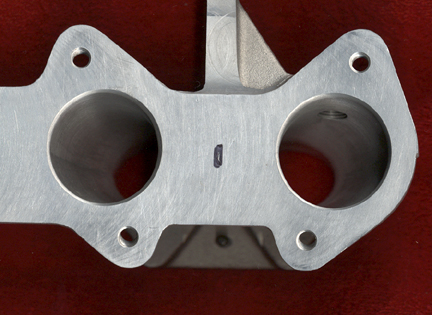
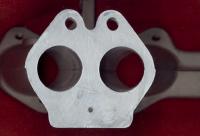
This is the head side.
-
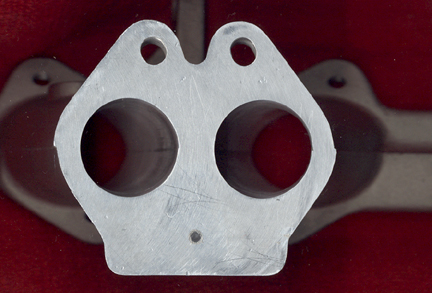
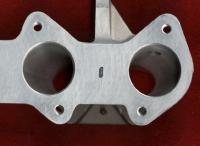
FWIW I just set up a new TWM manifold with 45 weber's. All it took to match the 45mm throttle bore to the manifold was a small radius blended into the runner. On the head side, the manifold was opened up very slightly to 36.5mm which is the size of my intake ports. the manifold is doweled to the head for proper alignment. The nice round holes and radius were done with a milling mach., and then the runners were smoothed up. The manifold in stock form had a 42.5mm bore. The manifold runner length is only 4 in. and has a nice smooth taper down to the port dia. To maintain the velocity, and the lower torque, keep the head port dia. as small as practical. This setup is for a .040 over F54 with a stroker crank. Phred
-
Stock head Thickness is 4.250 as I recall. It may be possible to find a place on the side of the head where you can measure it with some digital calipers. I havn't tried this though, I've always measured them on the bench. Phred
-
Hey Carl, Talk about trivia!!! I have been fiddling with SU's since 1967 (on my first car, a Bugeye) and never new what SU referred to. Thanks, I hadn't learned anything today till I read your post. Good job. Phred
-
Hi Gary, Long time, no see. Don't lose any sleep over that crud. Sounds like you got rid of it. I've seen many engines like that. Which doesn't make it right, not uncommon though. A very small amount of oil which slips by the guide seals over time, mixed with a slight amount of fuel is the culprit. It starts growing when you shut off the motor, the back of the valve has this odd mix on it which starts to thicken when the motor cools down. Then the process starts all over again next time you run it. After a while it starts to build up, untill it looks like what you had. The reason its on the Intake valve, is the vacume present in the intake system behind the throttle plate. The seals are good enough to keep most of the oil in check, but not all of it. You won't see it on the exh. valves because the exh. pressure blows any deposits out or up the exh. guide. If theres enough oil present in the mixture, The back of the exh. valve will get a burnt brownish crud there too. Hang in there Gary. Phred
-
Most of the racers use flexible ducting called SCAT ducting hose. SCAT is designation for ducting hose with a certain specification. It is used in the aviation industry for routing air through the cowling for the intake system, and for heating/cooling entering the cockpit. It comes in sizes -2 thru -24, or 5/8 thru 6 inches. The most common use for racers is brake ducting, the stock car guys use it to route cooling air within the interior as well as intake cold air systems. Your engine likes to breath cold air, I did testing many years ago, on intake temp vs. horsepower. As I recall, there was a 1% increase in horsepower for each 7 to 10 degrees ( depending on air density and barometric pressure) of temp. change. Testing range was from ambient (68 to 72) to our particular under hood temp. of about 140 degrees. So you can lose or gain enough horsepower to make the investment worthwhile. Phred (ex. A & P mech. ex. racer, current race engine builder)
-
More on the order of 5 to 7%, and only if properly jetted on a dyno. Phred
-
I was asked again today what kind of assembly lube should be used when installing a new cam. So I thought I would pass this along since I see a lot of questions regarding cam installation. First, if its a new cam, always use the manufactures recomended lube. But if you have a cam, and have no lube, pick up a small can or tube of cam assembly lube from your local hotrod shop. This is usually a mixture of high pressure lube and Molybdenum Disulfide, or abbreveated as Mos2. Wipe this on the lobes and rocker contact pads. Use regular engine assembly lube, or engine oil on the journals. Additionally, a product marketed by GM called EOS (engine oil supplement) part# 1052367 should be added to the crankcase. Change oil after after no more than 500 mi. as this is strictly a break in additive. It is an excellent product I have used for over 25 years. Your local Chevy Parts dept. should have it on the shelf. And remember, new cam new rockers. If its a performance cam, check the contact pad wipe pattern, a tube of Prussian Blue marking compound (from NAPA) is helpfull here, and center it by adjusting lash pad thickness. Phred
-
Yes, you can do this yourself. I have swapped many cam tower sets onto other heads. Consider: the towers have a dowel around each bolt, the top of the head is flat (hopefully), so the towers shouldn't care what there bolted to. Do what Lance suggested, and be carefull to torque the bolts to 12 lbs. min., not to exceed 14 lbs. Also put a little engine oil on the threads, a bolt should never be torqued into aluminum with dry threads. Phred
-
Try: www.piercemanifolds.com
-
I raced various cars with SU's for years and never ran more than three pounds. Question for you guy's with the Z Therepy video, what pressure do they recomend? Phred